Leeks and greens springtime pie

I’m a big fan of the weekly veg box. There’s something quite exciting about not choosing your own produce but simply going with whatever is in season and is in good supply.

The veg box didn’t always suite my lifestyle though. Back in my crazy 20s when we lived in Bristol, in the days before children, when I was working full-time yet still partying hard, I first ventured down the veg box path.

It was around the time that I was just beginning to develop an interest in food and cooking, and the idea of a weekly delivery of fresh organic vegetables seemed a right-on thing to do.

Problem was the vegetables would arrive and I simply had no idea what to do with them, or indeed what some of them actually were. I’d get home from work, wanting to make a quick supper before meeting friends at the pub, and end up just staring blankly into the fridge at a gnarly celeriac or pile of sweet potatoes and having not the slightest scooby what to do next.

And eating greens week-in-week-out just wasn’t turning me on. It took me right back to my Cranks childhood

But life is very different now that I’m all grown up. The veg box suits me and my family. As you have probably spotted already, I’m rather into meal planning. Each Sunday night I sit down at my laptop surrounded by recipe books, plan out my family’s meals for the week, and place my online order for all the groceries needed.

No meal makes it onto the plan though until I’ve consulted the Riverford website, where they list the contents of the coming week’s veg boxes. I love reading through the list of produce and letting my brain whir into action as it comes up with meal ideas.

But sometimes inspiration doesn’t arrive of its accord and the Riverford website itself is a marvellous treasure trove of recipe ideas for every vegetable (and fruit) under the sun. And because I was running short of ways to cook leeks, I came across a Riverford recipe for Flamiche, which turns out to be a Belgian leek pie.

I don’t think I’ve cooked a Riverford recipe yet that has disappointed, and this was certainly no exception. The creamy, buttery leeks combined with tarragon and nutmeg, encased in a light shortcrust pastry made for a tasty supper on one of our regular Meat Free Mondays. We ate it cold for lunch the next day and it was equally good, so I reckon this pie would be great for a picnic.

So here is my slight variation on the Flamiche, which has some spring greens thrown in, just because I happened to have those in the fridge too. It’s ever so easy to make, particularly when you use ready-made pastry. And no it’s not cheating – everyone does it!

Leeks and greens springtime pie

Serves 6

500g ready-made shortcrust pastry
600g leeks, washed, trimmed and sliced
200g spring greens, washed and shredded
6 tbsp creme fraiche
60g parmesan cheese
1 tbsp chopped tarragon leaves (I couldn’t find fresh so used dried, which worked perfectly well)
nutmeg, freshly grated
salt and pepper
1 egg yolk, beaten

Preheat the oven to 200ºC/gas mark 6.

Gently cook the leeks in butter until soft and translucent. Add the spring greens and stir into the leeks until the greens wilt.

Pour the leeks and greens into a large bowl and allow to cool.

Butter a quiche dish. Halve the pastry and roll out one half into a large circle and line the dish. Prick the bottom with a fork. Roll out the other pastry half into another circle the same size and cover with clingfilm for later.

When the leeks and greens have cooled, add the creme fraiche, nutmeg, parmesan and tarragon. Season well. Spread the mixture evenly over the pastry base.

Next brush some egg yolk over the exposed edges of the pastry, and place the other pastry circle over the pie filling and pinch the edges to seal.

Brush the top with more egg yolk and use a sharp knife to make a cross-shaped slit in the middle so that steam can escape.

Bake in the oven on a baking sheet for 30-40 minutes until the pastry is golden. Serve warm or cold with a side salad.

Homity pie


Before I go any further I want to say that Cranks today is probably quite different from how I remember Cranks growing up in the 1980s.

My step-mum was a big fan of Cranks. When we went shopping in the West End, we’d invariably end up in the Cranks restaurant just off Carnaby Street and we ate many dishes from their recipe book.

In case you don’t know Cranks, they’ve been around since the 1960s and were one of the first brands I’m aware of that were exponents of healthy eating. This of course is fantastic. But as a kid, I grew to associate Cranks with worthy food: brown rice, heavy wholemeal pastry, nut roasts and – this for me was the worst part – wholemeal pasta. Now I know we need roughage in our diet. But there is a right way and a wrong way to eat your fibre, and a bowlful of wholemeal spaghetti is for me most definitely the wrong way.

I’ve just taken a peek at the Cranks website. They are still going strong it seems and they look very different from the Cranks I knew growing up. There are some recipes I’d actually be quite interested in trying.

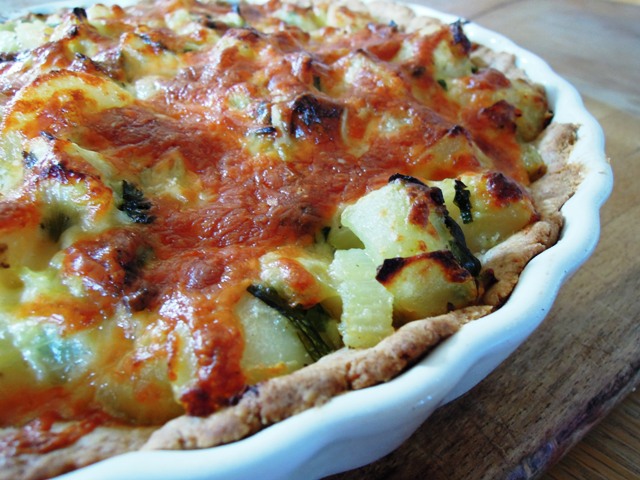
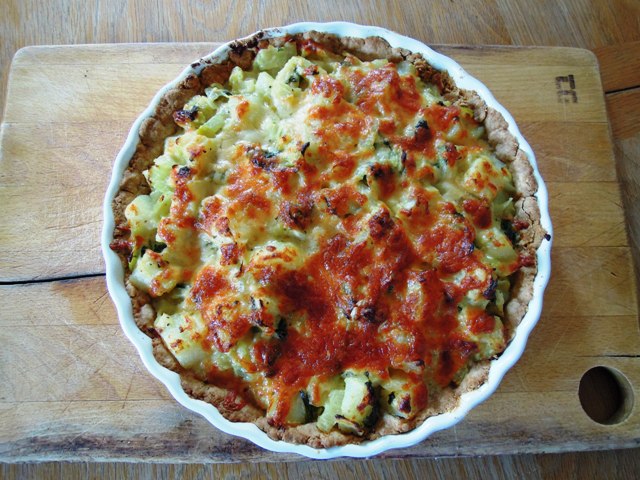
Despite my lack of enthusiasm for Cranks as a youngster, there was one dish that my step-mum could make time and time again from their recipe book and I’d be happy, and that was Homity Pie – a tasty open cheese and potato pie. OK so it was made with wholemeal pastry but I could cope with that when balanced with the lovely buttery, cheesey, garlicy potatoes and onions. As with all my favourite foods, so very simple and so very delicious. In fact, when I left home for university, this was the only recipe I copied out to take with me.

I’ve played with the recipe a little. I use half wholemeal and half white flour for the pastry. Sometimes I add ham or bacon to the filling. And quite often I add whatever leftover vegetables I happen to have in the fridge. Last time I baked it, I used half a celeriac I had hanging around, so this appears in the recipe below.

Homity Pie

For the pastry

100g plain white flour
100g wholemeal flour
2 tsp baking powder
pinch of salt
100g butter
3 tbsp water

For the filling

300g potatoes, peeled and diced
300g celeriac, peeled and diced
3 tbsp olive oil
450g onions, peeled and chopped
50g butter
handful fresh parsley, chopped
150g Cheddar cheese, grated
2 garlic cloves, crushed
1 tbsp milk
Salt and pepper

Preheat oven to 220°C/gas 7.

To make the pastry, place the wholemeal and white flour, baking powder and salt in a basin and rub in the butter with your finger tips until you have a breadcrumb-like mixture. Gradually add the water and mix in with a knife to form a dough. Wrap in clingfilm and leave in the fridge for 20 minutes.

In a large pan of salted water, boil the potatoes and celeriac until just tender, then drain and return to the pan.

Heat the olive oil in a pan and gently sautee the onions until golden. Add the onions to the potatoes and celeriac along with the butter, parsley, 100g of the cheese, garlic, milk, salt and pepper and combine well.

Butter your flan dish – I use one that’s 25cm diameter. Take your dough out of the fridge and roll out on a floured board. Don’t worry if it’s quite crumbly. Mine always falls apart a bit and I end up moulding it into position to line the flan dish.

Simply tip your ingredients into the pastry case, flatten it out a bit so the pastry is well covered and sprinkle with the remaining Cheddar cheese.

Bake in the oven for 25-30 minutes until the pastry is crisp and the cheese topping has melted and is golden brown.

Roast vegetable lasagne

Lasagne has always been one of my favourite foods. I loved it when my mother cooked it when I was little and I now love making it for my own children.

It’s not a quick dish to prepare though. In fact I used to think it was a bit of a faff. But these days, when I’m juggling work and family, it’s one of the meals I’ll make once the kids are tucked up in bed and I have the kitchen to myself, generally listening to Jo Whiley on Radio 2, all ready to eat the following evening. There’s nothing nicer than getting back from work and simply having to pop supper in the over and it’s all done.

We’re trying to eat less meat in our house. It’s partly to save money, partly for environmental reasons and partly to eat more healthily. And this is one of those vegetarian alternative meals where you really don’t miss the meat. It’s packed with big bold flavours and the aubergine and courgette give it lots of substance.

Because this meal is such a favourite with my clan, I’m submitting the recipe to The Pink Whisk Challenge, which is dedicated to raising awareness of Save the Children and the Hidden Hunger campaign.

Save the Children is asking everyone to Name a Day, a day when they will do just one thing to help save children’s lives. And they are asking David Cameron to do the same. It is a terrible fact that we live in a world with enough food for everyone, yet hunger is still able to kill 7,000 children every day.  Can you help Save the Children put an end to this Hidden Hunger?

All the recipes gathered for the Pink Whisk Challenge will be collated and published in a Save the Children e-book to be sold to raise awareness and funds for the campaign. Do you have a family favourite to add? Please do. You have until 31 March 2012. Full details over at The Pink Whisk.

Use lots of fresh rosemary and keep the vegetables nice and chunky

Roast vegetable lasagne

Serves 6

For the roast vegetables

1 small onion, peeled and quartered
3 courgettes, chopped diagonally into thick slices
2 aubergines, chopped into large chunks
1 red and 1 green pepper, deseeded and sliced
6 cloves of garlic, skins removed
handful of cherry tomatoes
4 sprigs of fresh rosemary
salt and pepper
olive oil

For the cheese sauce

50g butter
40g plain flour
450ml milk
100g Cheddar cheese, grated
salt and pepper

For the tomato sauce

1 tbsp olive oil
1 small onion, peeled and finely chopped
2 x 400g tins chopped plum tomatoes
2 tsp balsamic vinegar
salt and pepper

250g lasagne sheets
Extra grated cheese for sprinkling on top

Preheat oven to 200°C/gas 6.

Begin by roasting your vegetables. Place them all in a large roasting tray along with the rosemary and garlic. Season generously with salt and pepper, pour over some olive oil and toss together to cover the vegetables well. Roast in the oven for around 40 minutes, turning the vegetables halfway through, until they are tender and beginning to brown.

The roast vegetables with garlic and rosemary smell sensational

While the vegetables are roasting prepare the two sauces.

The tomato sauce is very simple. Fry the onions in the olive oil until golden. Add the tomatoes and balsamic vinegar and stir together. Simmer gently for around 15 minutes until the sauce has thickened. Season to taste.

A very simple tomato sauce

For the cheese sauce, place the butter, flour and milk in a saucepan. Whisk over a gentle heat until it has thickened. Then stir in grated cheese until it has melted into the sauce. Again, season to taste.

When the vegetables are roasted, place a layer of these in the bottom of a large ovenproof dish. (Mine isn’t particularly large so I use a medium sized one and a small one.) Make sure you pull out the thick rosemary stalks. Nobody likes chewing on twigs.

Pour some tomato sauce over the vegetables and then cover with a layer of lasagne sheets. Repeat this process until you have filled your dish, ending with a layer of vegetables and then sauce.

Now pour over the cheese sauce. I like to wiggle the dish from side to side a little to make sure the cheese sauce seeps down the sides and through all the cracks.

Finally scatter some grated Cheddar cheese over the top. Place in the oven for about 30 minutes until the cheese is browned and bubbly and a knife inserted goes easily through the pasta.

Perfect served with a salad and some homemade garlic bread.

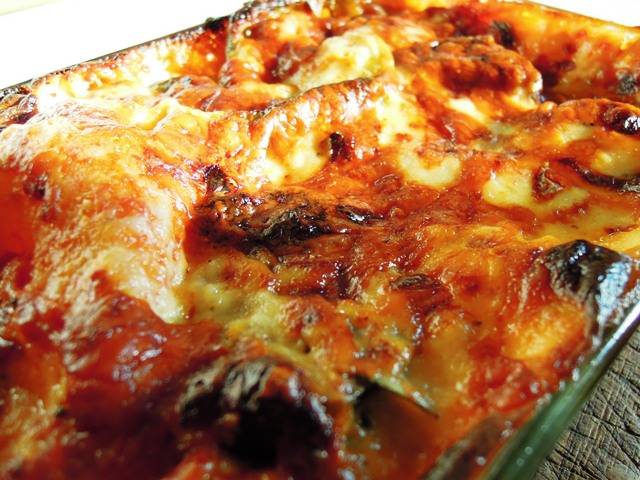
Who can resist the molten cheese on top of a big bowl of lasagne?

Haricot bean and garlic dip

I am rather partial to wraps at the moment. I like to eat them stuffed full of salad, cheese and different dips. They make for a really simple supper at the end of a busy day.

This haricot bean and garlic dip is  one of my favourites to have in a wrap. It’s also great served as part of a mezze. Similar to hummus, it is very cheap to make. The garlic is roasted with rosemary giving the dip a soft smoky flavour, which isn’t overpowering.

Haricot bean and garlic dip

4 heads of garlic
4 tbsp olive oil
2 stalks fresh rosemary
Salt and pepper
1 onion, peeled and chopped
1 (400g) tin haricot beans, drained and rinsed
1 tbsp ground cumin
5 tbsp soured cream
Juice of 1 lime
1 tsp paprika

Preheat oven to 190°C/gas 5.

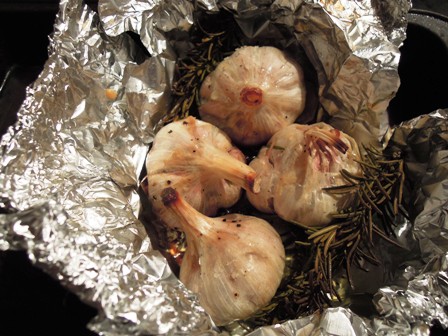
Toss the garlic in two tablespoons of olive oil, salt and pepper, and then loosely wrap in foil along with the rosemary. Bake on a tray for around 45 minutes until the garlic is soft and the skins come off easily.

In a saucepan, heat the remaining oil and fry the onion until it is golden brown.

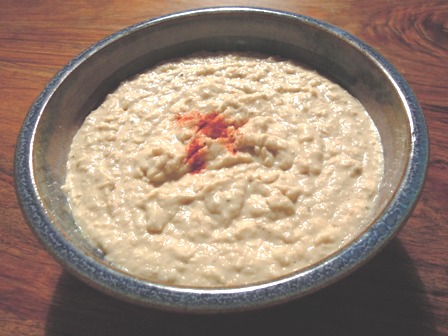
Squeeze the garlic out of their skins into a food processor with the onion, haricot beans, cumin, soured cream, lime juice and a little of the rosemary. Season well with salt and pepper. Blend until it resembles porridge. You don’t want it too smooth; it’s good to have a bit of texture. Taste and add more salt and pepper if needed.

Pour into your serving dish and garnish with a sprinkling of paprika.

Olive and mozzarella muffins

I seem to be going through a bit of a phase a the moment baking savoury muffins for our lunch boxes, and this is my latest creation.

It actually started life as a pizza muffin. My daughter Jessie loves pizza toppings and asked if we could make a muffin with these same ingredients. So we gave it a go. But despite being very tasty, they just didn’t quite taste like pizza. Which is why we’ve named them olive and mozzarella muffins instead.

Olive and mozzarella muffins

Makes 12

60ml sunflower oil
180g self-raising flour
130g wholemeal flour
1 tsp baking powder
½tsp bicarbonate of soda
Salt
1 tbsp dried oregano
130g black olives, chopped
2 eggs, lightly beaten
100ml plain yoghurt
275ml milk
1 tbsp tomato puree
125g mozzarella, chopped

Preheat oven to 200°C/gas 6. Oil and line a 12-hole muffin tin with baking paper or muffin cases.

Sift the self-raising and wholemeal flour into a large bowl, along with the baking powder and bicarbonate of soda. Stir in the salt, oregano and black olives.

In another bowl, mix together the eggs, yoghurt, milk and tomato puree. Pour these wet ingredients into the dry ingredients and very gently combine together. Carefully stir in the mozzarella pieces, keeping back a few pieces to place on top.

Spoon the mixture into the muffin cases and pop some extra bits of mozzarella on top of each one.

Bake the muffins in the oven for around 25 minutes until they well risen and a skewer inserted into the middle comes out clean. Eat warm or cold.

I’ll keep working on the pizza muffins and I’ll let you know when I’ve sussed them!

Three ways with butternut squash

Lorraine Pascale muffins
Riverford risotto
My soup

A rather large butternut squash arrived in our veg box last week. So as well as making my usual soup, I thought I’d try out a couple of new recipes on the family.

The first of these was a Lorraine Pascale recipe I’d seen her do recently on TV – pumpkin and rosemary muffins.

Pumpkin and rosemary muffins from a Lorraine Pascale recipe

It’s a great recipe, ever so easy, and would definitely recommend you try it. My husband and I enjoyed the muffins one lunchtime. We had them warm, with a little butter and some mature Cheddar cheese on the side.

Unfortunately our daughters were  not so impressed to find them in their lunch boxes at school and nursery. I think perhaps the rosemary was too overwhelming a flavour for them. Oh well, you can’t win them all, but you’ve got to try!

So I put the remainder in the freezer and I look forward to enjoying them at some point, sans enfants.

I won’t write out the recipe for pumpkin and rosemary muffins here but instead direct you to the BBC Food website.

The muffins used about a quarter of the butternut squash. I took another quarter for a squash risotto as inspired by the lovely people at Riverford Organic, who deliver our weekly veg box.

Riverford’s squash risotto

Now this was a success with the whole family, almost. The kids really enjoyed it, wolfing it down in seconds. It’s easy to eat, so very good for toddlers and babies getting to grip with new textures. My husband did quite like it I think, despite a few comments about the lack of meat. Which is normal from him.

This is another simple recipe. I only used half the quantities given in the Riverford recipe and I still had enough to feed two adults and two children, with a couple of portions left over for the freezer.

With the remaining half of the squash I cooked up a big pan of soup. Butternut squash makes for a very satisfying soup and children in particular love it, probably because they’re rather partial to those sweet flavours.

Roasted butternut squash with rosemary

I usually boil the butternut squash with the potato but this time it had already been roasted, as I’d needed cooked squash for the other recipes. I think I prefer it this way. It gives the soup a slightly more smokey flavour which is delicious.

Butternut squash soup

2 tbsp olive oil
1 onion, peeled and chopped
1 small butternut squash, peeled, deseeded and diced
1 potato, peeled and diced (if you like a thicker soup, add another potato)
1 litre vegetable stock, hot
Salt and pepper

Heat the oil in a large pan and add the onion. Gently fry until golden.

Add the squash and potato and cook for a minute or two before pouring in the hot stock.

Bring to a gentle simmer, then cover and cook for 15 minutes.

Liquidise the soup until smooth using a handheld blender or in a jug liquidiser. Season to taste with salt and pepper.

It’s lovely to have homemade soup ready to warm up when you’re forced to grab lunch at your desk

As butternut squash is in season right now and in plentiful supply, I’ve entered this post into the Simple and in Season blog event for February over at Fabulicious Food.

I love the idea behind this blog event – highlighting the best of what’s in season now and sharing recipes using those wonderful ingredients.

Some gorgeous looking recipes have already been posted, and I look forward to seeing many more over the coming month.

If you’ve got a recipe using seasonal ingredients, you should check it out!

Carrot, coriander and ginger soup

Soups are wonderful. They’re so simple to make and great for a quick lunch with crusty bread, and at tea time I often give my girls a bowl of soup and a sandwich.

Carrot and coriander soup is one of our family favourites. Now and again I add ginger to give it a little extra zing, perfect to warm the bones on a chilly day.

I like to cook up a big pot of soup on a Sunday to warm up for lunches through the week.

Ingredients

1 tbsp sunflower or vegetable oil
1 onion, peeled and chopped
1 piece of ginger about as long as your thumb, peeled and finely chopped
8 carrots, peeled and sliced
1 potato, peeled and diced
1 litre vegetable stock, hot
1 large bunch fresh coriander, roughly chopped
Salt

Heat the oil in a large pan and add the onion. Gently fry until golden, then add the ginger and cook for two minutes.

Add the carrots and potato and cook for a minute or two before pouring in the hot stock.

Bring to a gentle simmer, then cover and cook for 15 minutes. Stir in the coriander (reserving a little for garnish) and cook gently for another minute.

Liquidise the soup until smooth using a handheld blender or in a jug liquidiser. Taste and add a little salt if needed.

Serve with a little chopped coriander on top.

Beetroot and potato dauphinoise

I came across this delicious dish at one of our local pubs this Christmas, the excellent Holcombe Inn, and decided then I would have to recreate it at home.

It’s a lovely way to use beetroot, which is in plentiful supply at the moment, and is very good served with roast meats. My children really like beetroot, perhaps because it’s quite sweet.

Slice the beetroot and potatoes as thinly as you can. It’s best to use a mandolin if you have one.

This is a perfect dish for the Aga as it needs to be cooked slowly in a low oven.

Beetroot and potato dauphinoise

Serves 2

3 large potatoes, peeled and thinly sliced
2 large beetroot, peeled and thinly sliced
Salt and pepper
Handful fresh thyme, picked
4 cloves garlic, crushed
150 ml double cream, perhaps a little more
Butter

Preheat the oven to 160°C/Gas Mark 2.

Put the sliced potato and beetroot in a bowl and season with salt and pepper. Add the thyme, garlic and cream and combine so that the vegetables are well covered.

Place in a small gratin dish and roughly arrange the potato and beetroot so the slices lie flat. I like to have a layer of potato and then a layer of beetroot and so on. Pack down well.

The cream should almost come to the top of the vegetables. If not, add a little more.

Fleck the top of the vegetables with a little butter and cover with foil.

Bake for around 1½ hours, until the potato and beetroot are tender. Increase the oven temperature to 220°C/Gas Mark 7, remove the foil and return the dish to the oven for another 10-15 minutes until the top has crisped up.