Every year, we always find ourselves stuck with a Christmas pudding at the back of the cupboard long after the festivities have ended. It generally ends up in the bin since it’s not something we can really cope with eating at any other time of year.
I’m not sure why I bother buying one, since I’ve never been a big fan. I think it’s just one of those things you’re supposed to have. It’s always there in case one of our many visitors suddenly has an urge to consume pudding on top of everything else we’ve already fed them.
So when I saw a recipe idea in the December edition of Red magazinefor Christmas pudding ice cream I had a feeling it might come in very handy. And indeed it did. It’s a much lighter dessert with a lovely hint of Christmas. You get all the festive flavour but without the dense stodginess.
I didn’t bother putting the ice cream in a bowl lined with cling film, nor turning it out before eating and decorating with walnuts and chocolate-dipped orange peel as the magazine suggested, although I’m sure this would look wonderful. Just the ice cream on its own was lovely, and one people find irresistible even if they don’t like Christmas pudding normally.
So if you’ve still got a pud lurking at the back of your cupboard, why not give this a whirl?
Ingredients
1 small Christmas pudding (or whatever you happen to have left over)
2 litres good vanilla ice cream
Slug of brandy (optional)
Cook your pud and allow to cool. Leave the ice cream at room temperature to soften a little and add the broken up pudding and brandy (if using). Mix well.
Pour into your container of choice (lined with cling film if you want to turn out for serving) and freeze for at least a couple of hours.
Decorate with nuts and fruits before presenting to your guests or, like me, simply serve on its own straight from the tub.
As I tucked into my bowl of trifle on Christmas Day, it occurred to me that we don’t eat trifle nearly as much as we should do.
It’s such a magnificently luxurious dessert, but one that is so easy to prepare. And so versatile too – you can be as creative as you dare trying out new combinations of fruits, alcohol, cake and toppings.
Trifle deserves to be dished up more often, rather than being reserved for the festive season.
So I offer you my most recent take on the glorious trifle, combining the sumptuous warming tones of Amaretto with the light fruitiness of white grapes and the crunch of toasted almonds.
You really ought to make your own custard but I had enough on my plate (quite literally) this Christmas. I reckon it’s perfectly acceptable to cheat and use a ready-made custard instead. Just make sure you use a good quality one, preferably with lots of vanilla.
I also made a non-alcoholic version of this for the children, replacing the Amaretto with apple juice.
So please do give this a try in the new year. I’ll be finding an excuse to make it again myself as soon as I can.
Amaretto and white grape trifle
8 large trifle sponges
Apricot jam
Half a glass of Amaretto
600 ml of fresh custard
500 g white seedless grapes, halved
600 ml whipping cream
2 tsp vanilla extract
1 tbsp icing sugar
100g almond flakes
Cut the trifle sponges in half, spread with the jam and sandwich back together. Arrange these in the bottom of a large, suitably pretty glass bowl; depending on the size of your bowl you may end up with two layers of sponge.
Sprinkle the Amaretto over the sponges. It’s hard to advise how much to use as this is very much down to personal taste. I love Amaretto and I love a boozy trifle, so I use lots. I generally pour some on, let it soak in, then add a bit more. I stand back and watch it soak in again, before adding some more. So use your own discretion here.
Place the grapes on top of the sponges and cover with a layer of custard.
Pour the cream into a large glass bowl and add the vanilla and sugar. Whip the cream with an electric whisk until it forms soft peaks. Carefully spoon the cream over the custard.
In a dry pan, lightly toast the almonds. Leave to cool for a few minutes before scattering liberally over the cream. Chill in the fridge for as long as you can resist before diving in!
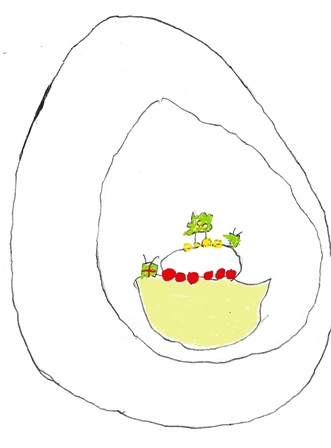
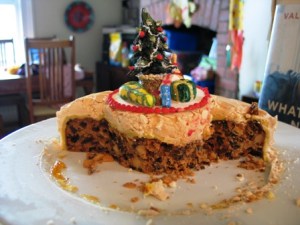
I promised myself some time off over the Christmas break from blogging and tweeting and the like, but my six-year-old has persuaded me to come online to show you their drawing of the Christmas cake I made this year.
This was my first-ever attempt at a Christmas cake. I baked it back in November and then dutifully ‘fed’ it whisky every week before icing it a few days before Christmas. We’ve all been very impressed with the result, even if the icing looks a little on the haphazard side! Despite all that whisky, it’s still very light, more like a stollen than the rich fruit cake you might be expecting.
For a while in the autumn we seemed to be getting beetroot in our veggie box pretty much every week. Now I adore beetroot so I was quite happy with this situation. Unfortunately the rest of my family do not share my passion for this colourful root.
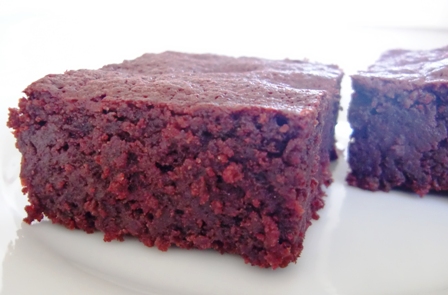
So while I was rather enjoying eating roast beetroot to accompany a joint of lamb or baked beetroot in a salad with nectarines, I felt compelled to come up with new ways to serve beets in a slightly less prominent way. That’s how I came up with this gorgeous brownie recipe.
They really are surprisingly good. Much lighter than your average brownie and ever so moist. Everyone I’ve served them to, including my anti-beetroot family members, has wanted more.
And I love the way they are tinged with a subtle pink hue.
I’ve tried this recipe with both plain and milk chocolate. Plain is definitely best here.
Wash and trim the beetroot, place in a baking dish with half a centimetre of water, and cover with foil. Place in an oven preheated to 200° C /Gas Mark 6 and roast for around 45 minutes until tender. Leave to cool and then skin.
Turn the oven down to 180°C/Gas Mark 4.
Put the chocolate and butter in a large bowl and microwave on a medium heat for two to three minutes, until melted. Stir together well.
Finely chop / mush the beetroot in a food processor. Then mix in the eggs one at a time, followed by the vanilla and sugar. Keep mixing until smooth.
Stir the beetroot mix into the melted chocolate, and then sift in the cocoa powder, plain flour and baking powder and fold in carefully, along with the ground almonds, until the ingredients are combined.
Line a tin, roughly 28cm x 18cm, with baking paper. Pour in the mixture and bake in the oven for 30 to 35 minutes, until just firm to the touch. Don’t over-cook your brownies! When they’re ready, a skewer should come out ever so slightly sticky.
Leave to cool in the tin and then cut into squares. Keep in an airtight container and eat within two to three days. If they’re around that long, that is.
‘You look a little shy; let me introduce you to that leg of mutton,’ said the Red Queen. ‘Alice – Mutton; Mutton – Alice.’ The leg of mutton got up in the dish and made a little bow to Alice; and she returned the bow, not knowing whether to be frightened or amused.
Alice’s Adventures in Wonderland: Through the Looking-glass, Lewis Carroll (1872)
I recently read a piece in the Independent by Samuel Mustonwhich suggested that mutton was making a bit of a comeback. This got me thinking: I’ve never actually eaten mutton, let alone cooked it.
Mutton has always sounded terribly old-fashioned to me. The kind of thing they ate in Victorian times or during the war because they couldn’t get hold ‘anything better’. As Muston says:
Even the word “mutton” sounds archaic and glottal; something from an age of crinolines and penny farthings. We are sophisticates, after all; we eat nice, soft, milky lamb. Two-year-old sheep went out with the ark, right?
Mutton is said to have a more complexity of flavour than lamb, a more gamey quality. You can compare the difference in flavour between mutton and lamb to that of chicken and guinea fowl. But you’d be mistaken in thinking mutton is cheaper than lamb just because its older. Quite often you pay a premium as it’s harder to get hold of.
More and more restaurants are now featuring mutton dishes on their menus. So if it’s good enough for them, it’s good enough for me. I decided there and then I was going to get hold of some of this “most British of foods”.
While some Waitrose stores now apparently stock mutton, I couldn’t find any in my local supermarket. So I turned instead to my local butcher Jon Thornerswho ordered some in for me: half a leg and some casserole meat.
So now I had my mutton, what to do with it? All the advice I came across says that long, slow cooking is best, a major contributor to why it’s decreased in popularity. These days, in our busy modern lives we just don’t have the time to cook it. The good people at Mutton Renaissance explain:
However, whilst many British consumers turned their back on mutton, it has remained highly valued in Asian, North African and Caribbean cuisine where long, slow marinades are combined with moist methods of cookery.
A mutton curry therefore seemed to me the most obvious thing to start with. Our friend Mikey, who’s living the good life in Cephalonia making wine, had recently been raving about a recipe for goat curry. It sounded perfect.
The verdict? Well, I can’t recommend this recipe highly enough. The meat was beautifully tender and the flavours both spicy and delicate. The meat needs to marinade overnight and it must cook for a few hours, so not a dish to rustle up quickly. But as they say, good things come to those who wait.
I’ll definitely make this again. But not until I’ve experimented with some more mutton recipes first. I’ll report back on those later. In the meantime, here’s the mutton curry recipe…
The aromatic spices give this curry an amazing depth of flavour
Mutton curry
Serves 4
For the marinade:
500g diced mutton
2 tsp chopped garlic
3 tsp chopped ginger
2 fresh green chillies, chopped
½ tsp chilli powder
1 tsp turmeric
2 tsp coriander powder
1 tsp cumin powder
½ tsp garam masala
1 tsp salt
In a bowl, add all the marinade ingredients to the diced mutton and mix well. Cover and keep in a cool place over night.
For the curry:
2 tbsp vegetable oil
3 cloves
1 star anise
1 cinnamon stick
4 cardamom pods
1 chopped onion
Marinated mutton
300ml chicken stock
1 can chopped tomatoes (crushed)
1 tbsp tomato puree
300g potatoes (peeled and chopped into large dice)
1 bunch fresh coriander (roughly chopped)
Salt and pepper
Heat the oil in a large pan, and then add the cloves, star anise, cinnamon stick, and cardamom pods. Cook the spices for a minute or so before adding the onion.
Cook the onions with the spices for 10 minutes then add the mutton. Stir and cook for 10 minutes, then add the stock, tomatoes and tomato puree. Cover and simmer over a low heat for about two hours. This is a perfect Aga dish. I cooked it in the bottom of our Aga for four hours.
When the meat is tender, add the potatoes and cook for another 20 minutes or so.
Remove from the heat, check the seasoning and stir in the coriander just before dishing up. Serve with rice or naan bread. Or both. I’m salivating just thinking about it.
If you ever need to rustle up some cakes for a school cake sale, these should do the trick.
Totally unsophisticated, completely garish and obscenely sweet. Just what little children are looking for in a cupcake.
I made these last week for the Christmas Fair and they disappeared within minutes of the doors opening.
And they can’t be that unhealthy; they do contain banana after all.
Banana and chocolate cupcakes
Makes 8 cakes
1 large ripe banana
110g soft butter
110g caster sugar
2 eggs
½ tsp vanilla extract
110g self-raising flour
For the icing 60g plain chocolate
25g butter
2 tbsp milk
2 tbsp golden syrup
Sweets of your choice for decoration – Smarties, jelly beans, dolly mixture – go crazy!
Preheat the oven to 180°C / 350°F / gas mark 4. Line a muffin tin with eight paper muffin cases.
Beat the butter and sugar until pale and fluffy. Whisk the eggs and vanilla in a separate bowl, then gradually add the eggs to the butter mixture, beating well.
Peel and mash the banana and stir into the butter mixture. Sift and fold in the flour.
Fill the muffin cases with the mixture and bake for 20 minutes, until risen and golden. Leave to cool.
To make the icing, put all the ingredients in a bowl and microwave on a medium heat for a minute or two, and mix well.
When the cupcakes are cool, spoon over the chocolate icing and decorate with your chosen sweeties.
It was the Christmas Fair today at our primary school and as a devoted PTA committee member, I was tasked with organising a non-alcoholic version of mulled wine to serve with mince pies.
This was a bit of a tall order as for me the whole point of a mulled drink is that it’s warming and boozy. But eventually I came up with this little number and you know what, it’s really rather good. It turns out you can have a Christmas drink that’s warming and non-boozy after all. Which is probably a good idea when you’re in charge of hundreds of children under the age of eleven.
Non-alcoholic mulled fruit punch
3 litres apple juice
3 litres cranberry juice
3 oranges, sliced
4 cinnamon sticks
5cm ginger, peel and chopped
Handful of cloves
Handful of star anise
This couldn’t be simpler. Into a large pan, pour in the apple juice and cranberry juice. Add the orange slices and spices and bring to simmering point. Keep just under boiling for about ten minutes before serving. People will come running when they smell those spices that just sing out “It’s Christmas!!!”




 This was a bit of a tall order as for me the whole point of a mulled drink is that it’s warming and boozy. But eventually I came up with this little number and you know what, it’s really rather good. It turns out you can have a Christmas drink that’s warming and non-boozy after all. Which is probably a good idea when you’re in charge of hundreds of children under the age of eleven.
 Bangers & Mash