Wild garlic risotto

I know spring has most definitely sprung when the scent of wild garlic starts wafting out from the hedgerows, which are completely overrun by them this time of year. As the weeks go on, the aroma can get really rather heady and pungent. Almost intoxicating on warmer days when the pretty white flowers are in full bloom.

Despite being in plentiful supply for at least a month of the year here in Somerset, I’ve never made much use of them other than adding a few chopped leaves in a salad here and there. But now that I’m a genuine foodie (well, I write a food blog don’t I?), I’ve decided it’s my duty to do more with them.

Also known as ransoms, buckrams, broad-leaved garlic, stinking Jenny, wood garlic, bear leek, bear’s garlic and gypsy’s onions, the wild garlic is a wild relative of the chive. It has a delicate taste, a delicious combination of chive and garlic. Both the leaves and the flowers are edible.

When thinking of recipe ideas for the wild garlic, two immediately came to mind: risotto and pesto.

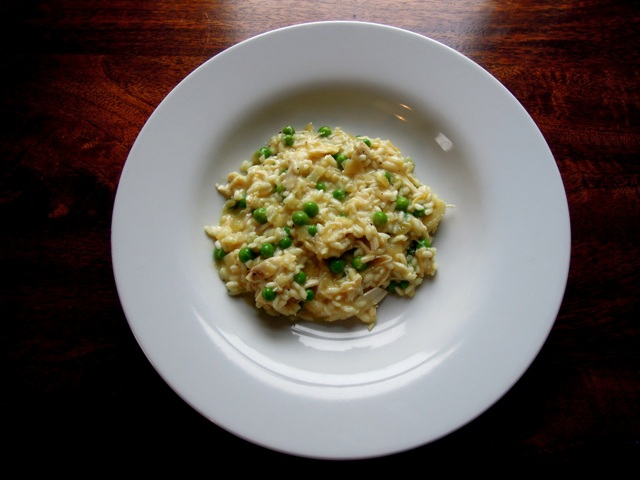
Last weekend we tried it in a risotto and it was an absolute triumph. Grown ups and children enjoyed it alike. I was impressed by the fact it tasted so special, almost extravagant, even though one of the main ingredients was completely free. Perfect family food on a budget. It felt good to pop down the lane with my oldest daughter, grab a few bunches and within half an hour or so turn it into a delicious feast.

I plan to try it in a pesto next week, so watch this space.

In the meantime, here’s my recipe for wild garlic risotto. I happened to  have some leftover chicken from another meal in the fridge so I’ve added this but I think it would work equally well without.
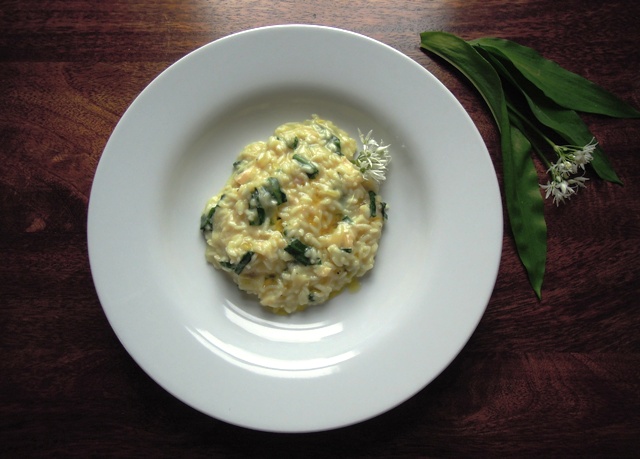
Wild garlic risotto

Serves 4

2 tbsp olive oil
1 onion, peeled and finely chopped
320g arborio risotto rice
1 litre hot chicken or vegetable stock
300g cooked chicken, torn or cut into bitesized pieces (optional)
2 large handfuls wild garlic leaves, washed and roughly shredded
100g Parmesan cheese, grated
Salt and pepper
Extra virgin olive oil and wild garlic flowers to serve

Gently cook the onion in the olive oil in a large frying pan for around 10 minutes until golden. Add the rice and fry for another couple of minutes.

Stir in the hot stock to the rice a ladleful at a time, allowing the liquid to be absorbed before adding more. Keep going until you have added almost all the stock.

As the last ladleful goes in, throw in the wild garlic and (if you’re using it) cooked chicken, and stir together for two to three minutes.

Just before serving, stir in the Parmesan cheese and a grind of salt and pepper to taste. Plate up, drizzle with a little extra virgin olive oil and decorate with a wild garlic flower or two.
Leeks and greens springtime pie

I’m a big fan of the weekly veg box. There’s something quite exciting about not choosing your own produce but simply going with whatever is in season and is in good supply.

The veg box didn’t always suite my lifestyle though. Back in my crazy 20s when we lived in Bristol, in the days before children, when I was working full-time yet still partying hard, I first ventured down the veg box path.

It was around the time that I was just beginning to develop an interest in food and cooking, and the idea of a weekly delivery of fresh organic vegetables seemed a right-on thing to do.

Problem was the vegetables would arrive and I simply had no idea what to do with them, or indeed what some of them actually were. I’d get home from work, wanting to make a quick supper before meeting friends at the pub, and end up just staring blankly into the fridge at a gnarly celeriac or pile of sweet potatoes and having not the slightest scooby what to do next.

And eating greens week-in-week-out just wasn’t turning me on. It took me right back to my Cranks childhood

But life is very different now that I’m all grown up. The veg box suits me and my family. As you have probably spotted already, I’m rather into meal planning. Each Sunday night I sit down at my laptop surrounded by recipe books, plan out my family’s meals for the week, and place my online order for all the groceries needed.

No meal makes it onto the plan though until I’ve consulted the Riverford website, where they list the contents of the coming week’s veg boxes. I love reading through the list of produce and letting my brain whir into action as it comes up with meal ideas.

But sometimes inspiration doesn’t arrive of its accord and the Riverford website itself is a marvellous treasure trove of recipe ideas for every vegetable (and fruit) under the sun. And because I was running short of ways to cook leeks, I came across a Riverford recipe for Flamiche, which turns out to be a Belgian leek pie.

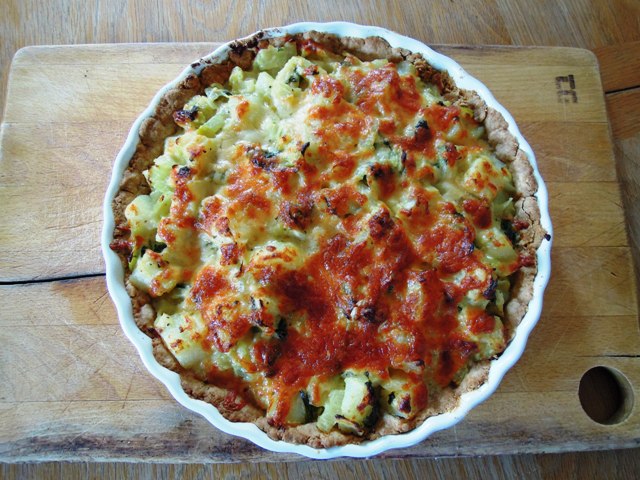
I don’t think I’ve cooked a Riverford recipe yet that has disappointed, and this was certainly no exception. The creamy, buttery leeks combined with tarragon and nutmeg, encased in a light shortcrust pastry made for a tasty supper on one of our regular Meat Free Mondays. We ate it cold for lunch the next day and it was equally good, so I reckon this pie would be great for a picnic.

So here is my slight variation on the Flamiche, which has some spring greens thrown in, just because I happened to have those in the fridge too. It’s ever so easy to make, particularly when you use ready-made pastry. And no it’s not cheating – everyone does it!

Leeks and greens springtime pie

Serves 6

500g ready-made shortcrust pastry
600g leeks, washed, trimmed and sliced
200g spring greens, washed and shredded
6 tbsp creme fraiche
60g parmesan cheese
1 tbsp chopped tarragon leaves (I couldn’t find fresh so used dried, which worked perfectly well)
nutmeg, freshly grated
salt and pepper
1 egg yolk, beaten

Preheat the oven to 200ºC/gas mark 6.

Gently cook the leeks in butter until soft and translucent. Add the spring greens and stir into the leeks until the greens wilt.

Pour the leeks and greens into a large bowl and allow to cool.

Butter a quiche dish. Halve the pastry and roll out one half into a large circle and line the dish. Prick the bottom with a fork. Roll out the other pastry half into another circle the same size and cover with clingfilm for later.

When the leeks and greens have cooled, add the creme fraiche, nutmeg, parmesan and tarragon. Season well. Spread the mixture evenly over the pastry base.

Next brush some egg yolk over the exposed edges of the pastry, and place the other pastry circle over the pie filling and pinch the edges to seal.

Brush the top with more egg yolk and use a sharp knife to make a cross-shaped slit in the middle so that steam can escape.

Bake in the oven on a baking sheet for 30-40 minutes until the pastry is golden. Serve warm or cold with a side salad.

Easter baking: hot cross buns

If you have no daughters, give them to your sons
One a penny, two a penny
Hot cross buns!

As regular readers of Bangers & Mash will know, I have a few insecurities when it comes to baking. Probably because around 50% of my efforts are complete flops. I put it all down to not being taught to bake as a child. But enough of the self-psychoanalysis. I am turning my baking life around. Who cares if a cake doesn’t rise occasionally and what’s a burnt biscuit or two between friends? The more I try, the better I get. Well, that’s the idea anyway.

One of my hands down successes recently has been hot cross buns. When I took these little beauties out of the oven, I can’t tell you how proud I felt. They looked just like proper hot cross buns. And they smelled amazing, simply filling the kitchen with sweet, spicy goodness. It’s going to be difficult bringing myself to eat the shop-bought variety again.

So if I can make these bad boys, anyone can.

What surprised me most wasn’t the fact they were easy to make. They were. But how quick they were to make. Isn’t bread supposed to be complicated? I did the first part before ballet lessons on a Saturday morning (OK there was a  15-minute kneading session, but I found that rather enjoyable), leaving the dough to rise while the girls did ‘good toe, naughty toe’. Then they took another ten minutes work when we got back, plus a little more rising time and then into the oven. You just need to factor in time for rising. They also freeze really well, so great to make in advance and simply whip them out when you need them.

This recipe is by The Fabulous Baker Brothers aka Henry and Tom Herbert, which appeared in the April edition of Delicious magazine. I’d been thinking about trying hot cross buns for a little while and when I saw them on the front cover I took it as a sign. I stuck pretty much to their recipe except I swapped zest for mixed peel, only because I still have a big pot left over from Christmas I’m trying to use up.

We ate some of the buns warm from the oven with butter and cheese for a light lunch, and some the following morning with strawberry jam. The rest went in the freezer for some easy homemade home-baked pleasure whenever I fancy!

Hot cross buns

Makes 16

680g strong white bread flour
2 x 7g sachets fast-action dried yeast
10g salt
100g caster sugar
80g soft butter
15g mixed spice
175ml milk, tepid
175ml water, tepid
1 egg
80g currants
80g sultanas
40g mixed peel

For the cross
100g strong white bread flour
Pinch of salt and sugar
25g butter, melted
125ml water

For the glaze
75ml boiling water
1 tbsp caster sugar
Pinch of mixed spice

Into a big mixing bowl put the flour, yeast, salt, sugar, butter (make sure it’s really soft), mixed spice, milk, water and egg. Stir well (you’ll need to put some effort in here) until  you have a loose dough. Add a little more water if the mixture looks dry.

Turn the dough onto a lightly floured surface and knead for 15 minutes until the dough is smooth. Gently work in the dried fruit and mixed peel. I stretched the dough out flat, scattered on a handful of fruit, folded the dough over and kneaded. And then repeated this until all the fruit was worked in.

Plop your dough back into the big mixing bowl, cover with a tea towel and leave in a warm place for at least 45 minutes until it has doubled in size.

Before...
...and after!

Line a baking tray with good high sides with baking paper. Turn the dough out of the bowl and cut in half using a plastic scraper. Divide each half into half again, then keep repeating until you end up with 16 pieces.

Roll the pieces firmly  in your hands to make pert round shapes. Arrange them in the baking tray in a four by four formation with half an inch between each bun. Cover the tin with a tea towel and leave in a warm place for 30 minutes or so until the buns have doubled again in size.

Preheat the oven to 210ºC/gas mark 6-7.

Combine the dry ingredients for the cross in a bowl and gradually whisk in the melted butter and water until you get a smooth mixture. Pour into a piping bag with a small nozzle. Cross the buns by piping continuous lines across the length and breadth of the tin.

Bake for 15 minutes until golden. While they’re in, make the glaze. Boil the water with the sugar and mixed spice for half a minute, then put to one side. As soon as the buns come out of the oven, brush the tops with the spicy glaze.


The Little Loaf is hosting the Fresh from the Oven challenge this month and as the theme this time is hot cross buns I thought I might enter mine. Now, the Little Loaf is an amazing baker so I’m a little nervous with my amateur offering but hopefully she’ll appreciate my enthusiasm!

Chocolate orange cupcakes

I am finally growing in confidence as a baker. For a long time I have thought of myself as a good cook but not a good baker. But slowly that is beginning to change.

Until recently I would never experiment with a cake recipe because baking just didn’t come naturally to me.

The world seems to fall into two camps: those who were born to bake and those who weren’t. I’ve always fallen into the second camp. But I’m gradually discovering  that baking can actually be learned. It’s as much about confidence in the kitchen as anything, a bit of practice and not giving up the first time things go pear-shaped.

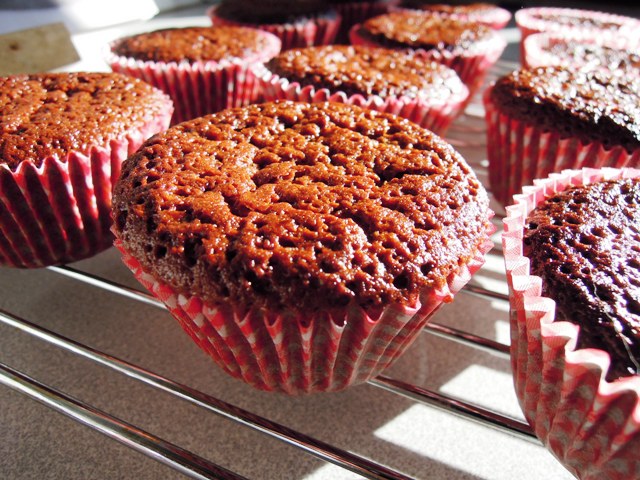
In recent weeks I’ve come up with my own recipe for pistachio scones and tried my hand at hot cross buns (recipe coming soon). And I’ve also come up with this recipe for chocolate orange cupcakes, which I’m really rather proud of. They’re sticky and gooey and indulgent and satisfying. My little girls asked for seconds. What more can you ask for?

Now don’t get me wrong. I’m not inventing recipes from scratch. Far from it. But I’m having fun playing around with other people’s recipes.

My experiments don’t always work out. A few weeks ago I tried making my version of a lemon tart using polenta and caraway. It was truly disgusting. I wasn’t too impressed with my Cheerio crunchies either – my attempt at using up a bulk purchase of a breakfast cereal my kids once loved then decided they no longer like.

Anyway, back to the chocolate orange cupcakes. The idea for these came from the good old Terry’s Chocolate Orange. Well, where else? I’ve used Nigella Lawson’s recipe for chocolate-cherry cupcakes as my starting point and then quite simply swapped the cherry ingredients for orange ones. Perhaps I’m being too honest here? That sounds too easy now I’ve typed it. But it did honestly feel quite inspired to me at the time…

Chocolate orange cupcakes

Makes 12

125g butter
200g plain chocolate
280g orange marmalade
1 orange, zest and juice
150g caster sugar
Pinch of salt
2 eggs, beaten
150g self-raising flour
100ml double cream
25g mixed peel

Preheat the oven to 180ºC/gas mark 4.

Melt the butter in a pan over a low heat and then add 100g of the chocolate. When the chocolate starts to melt, remove from the heat and stir in the marmalade, orange zest and juice, sugar, salt and eggs.

When it’s all mixed together well, stir in the flour.

Place 12 muffin paper cases into your muffin tin and spoon in the cupcake mixture. Bake in the oven for 25 minutes until the cakes have risen and are springy to the touch.

Cool in the muffin tray for 10 minutes or so, and then transfer to a wire rack until they are completely cool.

To make the icing, break up the remaining 100g chocolate into a saucepan and add the double cream. Bring to a gentle boil and then remove from the heat. Stir with a wooden spoon for a few minutes until the icing is smooth and thick. Use a tablespoon to ice the cakes and pop a few pieces of mixed peel in the middle of each one.

I just had a bit of a wobble and almost changed my mind about posting this recipe. Another blogger, a proper baking blogger with tonnes of followers, has just posted their recipe for chocolate orange cake. My confidence in my own food was zapped in a matter of seconds. But do you know what, I am going to press that ‘publish’ button. This isn’t a competition, after all. Is it?

Pistachio scones for a Mothering Sunday tea time treat

My mother’s favourite tea time treat is a plate of warm scones served with jam and cream. So when I started pondering on what recipe to post for Mothering Sunday, I really didn’t have to think for too long.

Unfortunately since my mum lives in Spain I won’t be able to bake these for her tomorrow, but I send these pictures to her with love and the promise I’ll make them for her the next time she’s over.

Until recently I’d only ever baked plain scones. I felt the whole scone experience was more about the indulgent toppings rather than the scone itself, which seemed to me essentially a carrier.

But as an avid fan of the Lavender & Lovage and What Kate Baked food blogs, I’ve realised this month just how versatile scones can be. The theme for their March Tea Time Treats challenge is scones and I’ve already heard on the Twittersphere of some delicious-sounding entries, from white chocolate to feta, tomato and caramelised onion.

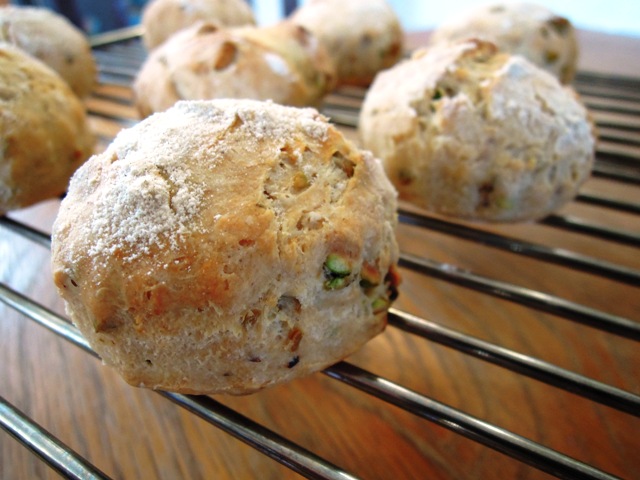
So I’ve put my thinking cap on and this is what I’ve come up with: dainty little pistachio scones seasoned with lots of black pepper for a slightly spicy, slightly Asian taste, which feel like they could easily have been part of a tea time spread enjoyed by the old colonials back in the days of the Raj. The pepper works particularly well with strawberry jam.

I like to make little diddy scones, the kind you can consume in a couple of bites. Or if you’re my husband, in a single mouthful. I used a 4cm circular pastry cutter for the scones pictured here.

And the secret to the perfect scone, according to Delia whose recipe this is based on, is to make sure you don’t roll out your scone dough too thinly. It must be at least 2cm thick.

Pistachio scones

Makes about 12

225g self-raising flour
40g soft butter
80g shelled pistachio nuts, roughly chopped
A pinch of salt and plenty of black pepper
150ml milk

Preheat oven to 220°C Gas 7.

Sift the flour into a mixing bowl and rub in the butter using your fingertips until it resembles fine breadcrumbs.

Stir in the pistachio nuts, salt and a good few grounds of black pepper. Remember these scones are meant to have a good peppery kick so don’t hold back.

Use a knife to gradually mix in the milk. Then use your hands to pull the mixture together into a soft dough, adding a little more milk if it seems too dry.

Place the dough onto a floured board and roll it out until it is no less than 2cm thick. Cut out your scones using your pastry cutter and place on a greased baking sheet.

Dust the top of each one with a little flour and bake for 12-15 minutes until they are golden brown. Cool on a wire rack and eat while they are still slightly warm. Serve with jam and whipped or clotted cream. Heavenly.

So what’s your favourite scone recipe? I’d love to hear it. And why not enter it into the March Tea Time Treats challenge as well? You’ve got until 28 March to take part.

Homity pie


Before I go any further I want to say that Cranks today is probably quite different from how I remember Cranks growing up in the 1980s.

My step-mum was a big fan of Cranks. When we went shopping in the West End, we’d invariably end up in the Cranks restaurant just off Carnaby Street and we ate many dishes from their recipe book.

In case you don’t know Cranks, they’ve been around since the 1960s and were one of the first brands I’m aware of that were exponents of healthy eating. This of course is fantastic. But as a kid, I grew to associate Cranks with worthy food: brown rice, heavy wholemeal pastry, nut roasts and – this for me was the worst part – wholemeal pasta. Now I know we need roughage in our diet. But there is a right way and a wrong way to eat your fibre, and a bowlful of wholemeal spaghetti is for me most definitely the wrong way.

I’ve just taken a peek at the Cranks website. They are still going strong it seems and they look very different from the Cranks I knew growing up. There are some recipes I’d actually be quite interested in trying.

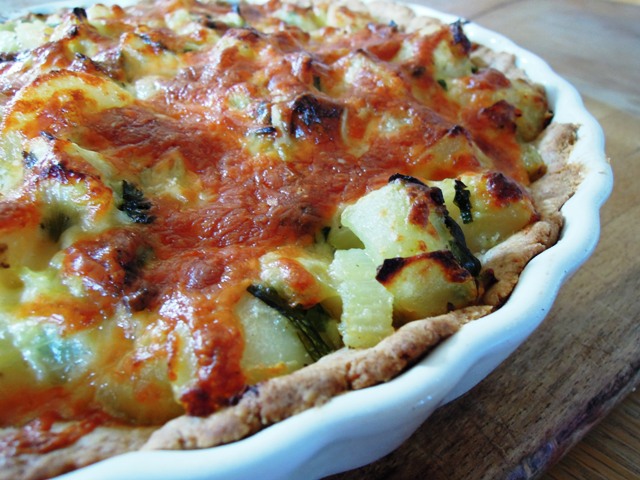
Despite my lack of enthusiasm for Cranks as a youngster, there was one dish that my step-mum could make time and time again from their recipe book and I’d be happy, and that was Homity Pie – a tasty open cheese and potato pie. OK so it was made with wholemeal pastry but I could cope with that when balanced with the lovely buttery, cheesey, garlicy potatoes and onions. As with all my favourite foods, so very simple and so very delicious. In fact, when I left home for university, this was the only recipe I copied out to take with me.

I’ve played with the recipe a little. I use half wholemeal and half white flour for the pastry. Sometimes I add ham or bacon to the filling. And quite often I add whatever leftover vegetables I happen to have in the fridge. Last time I baked it, I used half a celeriac I had hanging around, so this appears in the recipe below.

Homity Pie

For the pastry

100g plain white flour
100g wholemeal flour
2 tsp baking powder
pinch of salt
100g butter
3 tbsp water

For the filling

300g potatoes, peeled and diced
300g celeriac, peeled and diced
3 tbsp olive oil
450g onions, peeled and chopped
50g butter
handful fresh parsley, chopped
150g Cheddar cheese, grated
2 garlic cloves, crushed
1 tbsp milk
Salt and pepper

Preheat oven to 220°C/gas 7.

To make the pastry, place the wholemeal and white flour, baking powder and salt in a basin and rub in the butter with your finger tips until you have a breadcrumb-like mixture. Gradually add the water and mix in with a knife to form a dough. Wrap in clingfilm and leave in the fridge for 20 minutes.

In a large pan of salted water, boil the potatoes and celeriac until just tender, then drain and return to the pan.

Heat the olive oil in a pan and gently sautee the onions until golden. Add the onions to the potatoes and celeriac along with the butter, parsley, 100g of the cheese, garlic, milk, salt and pepper and combine well.

Butter your flan dish – I use one that’s 25cm diameter. Take your dough out of the fridge and roll out on a floured board. Don’t worry if it’s quite crumbly. Mine always falls apart a bit and I end up moulding it into position to line the flan dish.

Simply tip your ingredients into the pastry case, flatten it out a bit so the pastry is well covered and sprinkle with the remaining Cheddar cheese.

Bake in the oven for 25-30 minutes until the pastry is crisp and the cheese topping has melted and is golden brown.

Chicken and pea risotto

There are certain dishes that make you feel good simply by preparing them, even before you get to the eating of them. This risotto is, for me, one of these dishes.

It’s partly because it consists mainly of leftovers. The chicken comes from a roast chicken we enjoyed a couple of days earlier, while the stock was made from the bones of the same bird. Spreading ingredients over two or three meals in this way makes me feel quite virtuous, like a proper old fashioned cook.

And then there’s the way you cook a good risotto. It takes care and patience. You can’t turn your back on it for too long. It takes love, and in return you feel loved for making it.

People can be put off making risotto because they dislike the idea of having to stand over the pan, constantly stirring the rice. I know I used to be. But really, it’s only 20 minutes of your life, and it can be almost therapeutic to stand there and let  your mind wander. It’s almost like meditation.

Finally, of course, it tastes so good. Just a few simple ingredients and a bit of stirring and you end up with a creamy hug on a plate. Most definitely my idea of the perfect comfort food.

Chicken and pea risotto

Serves 4

2 tbsp olive oil
1 onion, peeled and finely chopped
2 cloves of garlic, peeled and crushed
320g arborio risotto rice
300g (approx) cooked chicken, torn or cut into bitesized pieces
1 litre hot chicken stock (homemade or from stock cubes)
250g frozen peas
100g Parmesan cheese, grated
Salt and pepper

Gently cook the onion in the olive oil in a large frying pan for around 10 minutes until golden. Add the garlic and rice and fry for another couple of minutes.

Stir in the hot stock to the rice a ladleful at a time, allowing the liquid to be absorbed before adding more. Keep going until you have added almost all the stock.

As the last ladleful goes in, throw in the peas and the chicken and stir together for two to three minutes.

Just before serving, stir in the Parmesan cheese and a grind of salt and pepper to taste.

Apple crumble muffins

We’ve got another cake sale coming up soon at my daughter’s primary school. These are definitely one of the PTA’s most successful ways to raise funds. You should see the number of homemade cakes the parents bring in. It’s very impressive.

I have a couple of standards I usually bake, which I know always get snapped up. The first is the banana chocolate cupcake, which I’ve featured here before. And the other is the scrumptious apple crumble muffin, the recipe for which I’ve taken from Linda Collister’s excellent book ‘Baking with Kids’.

I like to think of both these cakes as being vaguely healthy since they contain fruit. Obviously they also contain lots of butter and sugar too, so I don’t think you can really claim they’re a substitute for one of your child’s five-a-day!

The apple crumble muffin is a big hit in our house. The perfect combination of cake and pudding.

And as they contain apple, I’m entering this muffin into February’s In Season Challenge over at Make It Bake It, where the theme this month is any recipe containing apples.

Apple crumble muffins

Topping:

50g butter
50g sugar
50g plain flour
50g ground almonds

Cakes:

275g plain flour
2 tsp baking powder
175g caster sugar
1 lemon
150g butter
2 eggs
100ml milk
2 eating apples

Preheat oven to 190°C (375°F) Gas 5.

To make the topping, cut the butter into small pieces and put in a mixing bowl with the other ingredients. Work them together until it looks like crumble mixture.

For the cake mixture, sieve the flour and baking powder into a mixing bowl and mix in the sugar. Stir in the zest from the lemon and make a well. Pour the melted butter, beaten eggs and milk into the well, and mix gently.

Spoon the mixture into paper muffin cases in a 12-hole muffin tray. Core and roughly chop the apples and scatter on top of the muffin mixture, then sprinkle over the topping.

Bake for 30 minutes until golden brown. Enjoy with a cup of tea or a glass of milk!

Roast vegetable lasagne

Lasagne has always been one of my favourite foods. I loved it when my mother cooked it when I was little and I now love making it for my own children.

It’s not a quick dish to prepare though. In fact I used to think it was a bit of a faff. But these days, when I’m juggling work and family, it’s one of the meals I’ll make once the kids are tucked up in bed and I have the kitchen to myself, generally listening to Jo Whiley on Radio 2, all ready to eat the following evening. There’s nothing nicer than getting back from work and simply having to pop supper in the over and it’s all done.

We’re trying to eat less meat in our house. It’s partly to save money, partly for environmental reasons and partly to eat more healthily. And this is one of those vegetarian alternative meals where you really don’t miss the meat. It’s packed with big bold flavours and the aubergine and courgette give it lots of substance.

Because this meal is such a favourite with my clan, I’m submitting the recipe to The Pink Whisk Challenge, which is dedicated to raising awareness of Save the Children and the Hidden Hunger campaign.

Save the Children is asking everyone to Name a Day, a day when they will do just one thing to help save children’s lives. And they are asking David Cameron to do the same. It is a terrible fact that we live in a world with enough food for everyone, yet hunger is still able to kill 7,000 children every day.  Can you help Save the Children put an end to this Hidden Hunger?

All the recipes gathered for the Pink Whisk Challenge will be collated and published in a Save the Children e-book to be sold to raise awareness and funds for the campaign. Do you have a family favourite to add? Please do. You have until 31 March 2012. Full details over at The Pink Whisk.

Use lots of fresh rosemary and keep the vegetables nice and chunky

Roast vegetable lasagne

Serves 6

For the roast vegetables

1 small onion, peeled and quartered
3 courgettes, chopped diagonally into thick slices
2 aubergines, chopped into large chunks
1 red and 1 green pepper, deseeded and sliced
6 cloves of garlic, skins removed
handful of cherry tomatoes
4 sprigs of fresh rosemary
salt and pepper
olive oil

For the cheese sauce

50g butter
40g plain flour
450ml milk
100g Cheddar cheese, grated
salt and pepper

For the tomato sauce

1 tbsp olive oil
1 small onion, peeled and finely chopped
2 x 400g tins chopped plum tomatoes
2 tsp balsamic vinegar
salt and pepper

250g lasagne sheets
Extra grated cheese for sprinkling on top

Preheat oven to 200°C/gas 6.

Begin by roasting your vegetables. Place them all in a large roasting tray along with the rosemary and garlic. Season generously with salt and pepper, pour over some olive oil and toss together to cover the vegetables well. Roast in the oven for around 40 minutes, turning the vegetables halfway through, until they are tender and beginning to brown.

The roast vegetables with garlic and rosemary smell sensational

While the vegetables are roasting prepare the two sauces.

The tomato sauce is very simple. Fry the onions in the olive oil until golden. Add the tomatoes and balsamic vinegar and stir together. Simmer gently for around 15 minutes until the sauce has thickened. Season to taste.

A very simple tomato sauce

For the cheese sauce, place the butter, flour and milk in a saucepan. Whisk over a gentle heat until it has thickened. Then stir in grated cheese until it has melted into the sauce. Again, season to taste.

When the vegetables are roasted, place a layer of these in the bottom of a large ovenproof dish. (Mine isn’t particularly large so I use a medium sized one and a small one.) Make sure you pull out the thick rosemary stalks. Nobody likes chewing on twigs.

Pour some tomato sauce over the vegetables and then cover with a layer of lasagne sheets. Repeat this process until you have filled your dish, ending with a layer of vegetables and then sauce.

Now pour over the cheese sauce. I like to wiggle the dish from side to side a little to make sure the cheese sauce seeps down the sides and through all the cracks.

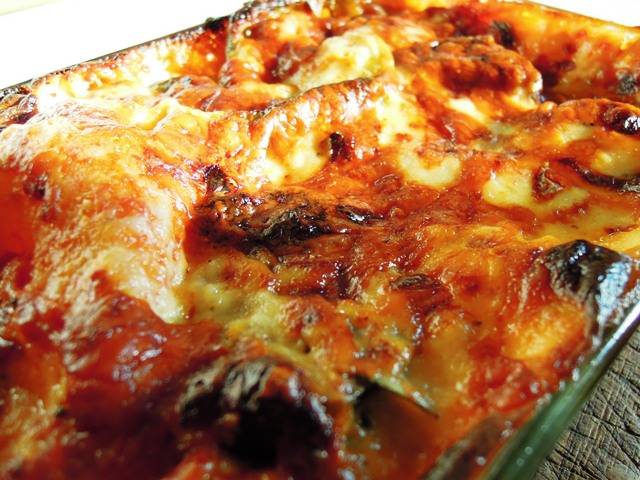
Finally scatter some grated Cheddar cheese over the top. Place in the oven for about 30 minutes until the cheese is browned and bubbly and a knife inserted goes easily through the pasta.

Perfect served with a salad and some homemade garlic bread.

Who can resist the molten cheese on top of a big bowl of lasagne?

Celery and blue cheese soup with crispy smoked pancetta

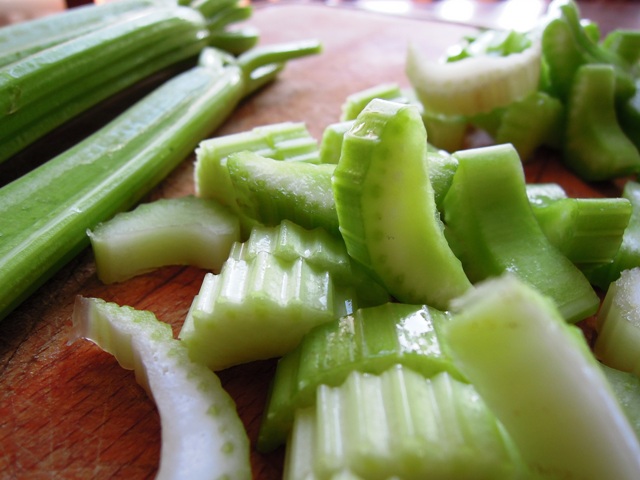
I think celery is a wonderful ingredient for soup. It can seem on the surface a bit of a nothingy vegetable; great for adding a bit of crunch to a salad but not particularly interesting in its own right.

Don’t get me wrong. I love celery in a salad but it is usually a bit part player.

But when cooked, it is transformed. The flavour deepens and intensifies. And combined as in this soup with the saltiness of smoked pancetta and a strong blue cheese, such as a Stilton or Blue Vinney, I really don’t think you can achieve much more pleasure in a bowl of food than this.

I make my celery soup with chicken stock plus a sprinkling of crispy pancetta to serve, but for a vegetarian version simply leave out the pancetta and use vegetables stock instead.

This is a perfect soup for a light but indulgent lunch and is also interesting enough for a starter when you have friends over for dinner. Its taste belies how simple it is to make. My children will eat it quite happily, but only if I omit to tell them there is any blue cheese in it.

Celery and blue cheese soup with crispy smoked pancetta

Serves 4

Large knob of butter
1 onion, peeled and chopped
5 large sticks of celery, chopped
2 potatoes, peeled and diced
800ml chicken stock, hot
75g blue cheese
50g pancetta, diced

In a large pan melt the butter and gently fry the onions until golden. Add the celery and potatoes and toss in the butter for a couple of minutes.

Pour in the hot stock and simmer for 10-15 minutes, until the celery and potatoes are tender.

Meanwhile fry the pancetta in a little more butter until crispy. Place on some kitchen towel so they are not too greasy.

Liquidise until smooth and then return to a gentle heat. Crumble in the blue cheese and stir until it has melted in. Check for seasoning at this point, but I’d be surprised if you need any.

Serve in bowls with a sprinkling of crispy pancetta. Soup doesn’t get sexier than this!