My little sis Elly with our Mum Cheryl (left) in Penang in the early 80s, and again with me (in the days when I was still bigger)
Our next entry for the Care to Cook Challenge comes from my little sister Elly. I say ‘little’ but must admit that Elly has towered over me for many years now, despite being five years my junior.
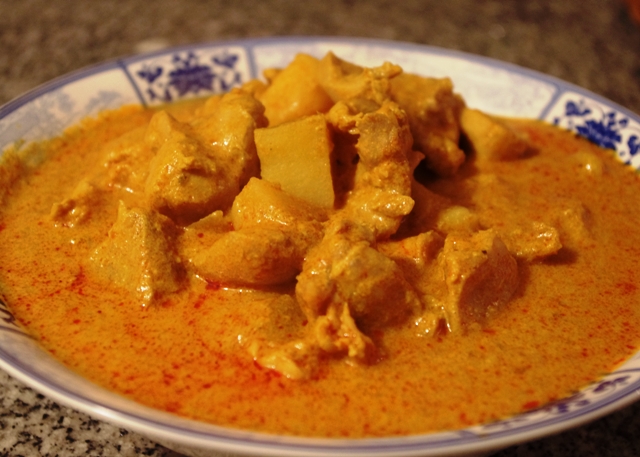
Elly has a very sweet tooth and I assumed when I asked if she’d submit a favourite recipe for this challenge, her contribution would certainly be a cake or pudding. But no, she’s gone and surprised me with this amazing looking Nonya Chicken Curry. My little sis is all grown up and is cooking very grown up food!
Nonya cuisine comes from the Malaysian island of Penang, where our Mum was born, and is now seen as one of the earliest examples of fusion food. Penang is a melting pot for different cultures and food from the Nonya kitchen is influenced by Chinese, Malay and Thai cooking. My sister Elly will tell you more…
I make this for my partner Kelvin and to this day he still says it’s the best chicken curry he’s ever had, which from a Malaysian is pretty high praise. And if we think perhaps he is a little biased, I also made it for his father (a lovely man but one of very few words) who told me, “It’s good.” I almost fell over – hehehe!
The method is pretty short so makes it look likes it’s going to be quick but if you really make it from scratch (ie grind and pound all the spices with a mortar and pestle), it’s quite a lot of work and you’ll end up with muscles. However, it is worth it and even just thinking of it is making my mouth water!
1.5 kg meaty chicken pieces
300g potatoes, peeled and cut into wedges
400ml thin coconut milk
100ml thick coconut milk
salt and sugar
Heat oil over a medium low flame and saute star anise, cloves and cinnamon stick. Add in spice paste and stir-fry well. Add 2 to 3 tbsp thin coconut milk (if it is too dry) and fry over low heat until fragrant and oil separates.
Add chicken and fry for a minute. Add potatoes and pour in thin coconut milk. Simmer until chicken is tender and potatoes are cooked.
Lastly, add the thick coconut milk and season to taste. Continue to cook until gravy is slightly thick. Serve with boiled white rice or roti.
Elly with her gorgeous daughter Loella
Do you have a favourite family recipe you’d like to contribute to TACT’s Care to Cook Recipe Challenge? Share a link to a post on your own blog or email me your recipe to be featured here on Bangers & Mash. The winning recipe will receive a copy of TACT’s cookbook signed by the charity’s patron and celebrity cook Lorraine Pascale. The closing date is 12 August – more details are here.
What dish would you cook to welcome someone into your family home? Share your favourite recipes and you could win a copy of TACT’s cookery book, signed by the charity’s patron Lorraine Pascale, who has personal experience of both the care system and adoption.
For the last few years I’ve been working with a wonderful charity called TACT, which provides fostering and adoption services to help some of the most vulnerable children and young people in the UK. Their aim is to help these youngsters find loving homes and a fresh new start in life.
In this time I’ve had the privilege to meet many amazing carers, adopters and staff who are making an incredible difference to the lives of the young people they work with.
The concept of family is very important to TACT; providing a safe, stable and caring home environment is so crucial and it makes a massive difference in supporting children and young people who find themselves in the care system for all kinds of reasons. Young people need to feel valued, made to feel special and loved, and need to be listened to when they are ready to share. That is what family is there for.
One of the simplest ways to bring family together and welcome new people into our home is through food. Family meals all too often are something children in care have missed out on. Because the family meal is so important, TACT has launched its very own cook book called Care to Cook, packed full of delicious starters, mains and desserts kindly donated by TACT’s adopters, supporters and staff.
The cost of the book is £3 and all proceeds directly benefit adopted children and their new families.
To help raise awareness of Care to Cook, Bangers & Mash is calling on food bloggers and food lovers to submit their own favourite family recipes, and one lucky person will receive a copy of the cook book signed by TACT’s new celebrity patron, TV chef and best selling cookery writer Lorraine Pascale.
Lorraine Pascale, patron of TACT, TV chef and cookery writer
How to submit your recipe
If you are a blogger and would like to enter the Care to Cook Challenge, simply post a recipe on your blog with links to both this page and the Care to Cook page on the TACT website and include the Care to Cook Challenge logo somewhere in your post.
The recipe can either be one of your own or somebody else’s but do remember to clearly credit your sources. You can republish an old blog post but please include information about the Care to Cook Challenge.
Your post can also be entered into other blogging challenges, so long as this complies with their rules.
If you mention your post on Twitter please mention @BangerMashChat and @TACTCare and use the #CareToCook hashtag. We will retweet all we see.
If you aren’t a blogger, don’t worry – you are still welcome to enter. Simply email your recipe (and a photo if you have one) to the above address and I’ll upload it to the Bangers & Mash blog for others to see.
The closing date for entries is Sunday 12 August 2012, and a round-up of all recipes submitted will feature here on Bangers & Mash and on TACT’s website the following week.
The winning entry will be chosen by one of TACT’s looked after children in the Bristol and South West region.
We can’t wait to see your family favourite recipes and please feel free to enter the challenge as many times as you like. Thanks for your support!
To get things started, here’s a fantastic recipe for Caribbean-style Pot Roast Chicken taken from Care to Cook. I tried it out on my own family last weekend and it is extremely yummy and very, very moreish. My daughters loved it – they asked for seconds and then thirds!
As my husband was tucking in to his, he asked where I got the recipe and I explained it had been donated by a TACT adopter for their cookery book. In between mouthfuls, Jason nodded and said: “Whoever Bernadette has adopted is very, very lucky. Her food is great!”
Pot Roast Chicken – Caribbean Style By Bernadette Biscette, TACT Adopter
Serves 6
1 whole medium free range chicken, cut in half
½ medium onion, peeled and chopped
1½ tbsp all purpose seasoning
1 tsp mixed herbs
1 tsp paprika
1 tbsp mild bajan or jerk seasoning
3 tbsp olive oil
1 tbsp brown sugar
For the gravy
Cup of hot water
1 tsp cassareep or molasses
1 tbsp tomato puree
½ medium onion, peeled and chopped
½ tsp all purpose seasoning
Preheat the oven to 150°C/gas mark 2.
Place the two halves of chicken in a large bowl and add the onion, all purpose seasoning, mixed herbs, paprika and bajan or jerk seasoning. Rub the seasoning into the chicken with your hands making sure it is well covered.
Pour the olive oil and brown sugar into a large iron or Dutch pot and heat until the sugar starts to brown. Place the two halves of chicken in the pot and slowly brown the surface by turning in the oil for around 15-20 minutes. (I had to do the two halves separately as I don’t have a pan large enough.)
When the chicken is well glazed, let them simmer on a low heat for 15 minutes.
Remove the chicken from the pot and place in a deep roasting pan and set aside.
Add a cup of hot water to the juices in the pot and all the ingredients for the gravy. Stir over a medium heat for 5 minutes and then pour over the chicken, cover with foil and cook for 2 hours in the oven, removing the foil for the last half hour. The chicken should be tender and well cooked.
Serve with salad and boiled rice for a hearty meal.
That was my husband’s reaction the other day when I told him we were having this chicken and noodle salad.
“But Mum! Noodles should be hot!” was Jessie’s response.
Mia took a mouthful of noodles and promptly spat them out.
Not the best of starts. But after a little cajoling and a bit of encouragement, things did get better.
“Actually, this isn’t bad,” Jason conceded in between mouthfuls.
Once Mia got used to the texture of the noodles, she was tucking in wholeheartedly. And Jessie polished hers off without any further fuss. “Yum,” she declared on finishing.
It can be so easy to serve up the same kinds of foods day in and day out but I’m one of those annoying mothers who likes to challenge her family’s taste buds. And it does pay off. Now they’ve got their heads around cold noodles in a salad, I think we’ll be coming back to this quite a lot.
It’s a beautifully freshy, zingy dish – perfect for summer, or at least helping to give the impression of a summer. The chicken thighs are poached so they are lovely and moist and the fresh coriander and mint, along with the lemon, ginger and garlic in the dressing, pack it full of flavour.
I also added some scrummy broad beans from the veg box; the ones in the garden aren’t ready yet. Shelling broad beans has to be one of my favourite jobs in the kitchen. It makes me feel like a 1950s mother for some reason.
If you were making an authentic South East Asian noodle salad, you probably should also use chilli and fish sauce in the dressing. I left these out because a) chilli would be a step too far for little Mia and b) my husband can’t eat fish – I know! How inconsiderate is that?! But if these sound good to you, go ahead.
Chicken noodle salad with coriander and mint
4 skinless chicken thighs
½ onion, peeled and chopped
5 kaffir lime leaves
small handful black peppercorns
200g vermicelli noodles
3 spring onions, finely sliced
1 carrot, grated
½ yellow pepper, deseeded and sliced
large handful shelled broad beans
large handful fresh coriander, chopped
large handful fresh mint, chopped
2 tbsp sesame seeds
6 lettuce leaves, shredded
Place the chicken thighs into a pan with the onion, 5 kaffir lime leaves and peppercorns and cover with water. Bring to the boil, cover and simmer gently for 15 minutes. Allow the chicken to cool in the liquid.
Cook the noodles according to the packet instructions. Drain and run under cold water to refresh.
Dry fry the sesame seeds for a couple of minutes until golden. Remove to cool on a plate.
Place all the dressing ingredients in a saucepan and heat until the sugar dissolves. Sieve into a jug and leave to cool.
Into a large salad bowl place the noodles, spring onions, carrot, yellow pepper, broad beans, coriander, mint, sesame seeds and lettuce. Pour over the dressing and mix well to ensure everything is well covered. I like to use my hands for this bit.
Slice the cooled chicken thighs, arrange on top of the salad and serve.
I’ve been making this simple cous cous dish since my first-born Jessie was about a year old. Based originally on an Annabel Karmel recipe, it’s a perfect dish for little ones who are getting to grips with solid food and new textures; just make sure you cut the meat and vegetables into smallish pieces. As they get older, the pieces can get bigger.
I used to make it just for Jessie until I realised how tasty it was, so I now regularly make it as a speedy supper dish for the whole family. We usually eat this hot but it’s also a great lunchbox filler.
Chicken with cous cous
Serves 4
200g cous cous
450ml hot chicken stock
1 tbsp olive oil
1 onion, peeled and finely chopped
1 chicken breast, diced
1 courgette, diced
2 cloves of garlic, peeled and crushed
2 tomatoes, diced
Handful fresh basil, roughly torn or chopped
Salt and pepper
Put the cous cous in a large bowl, add the hot stock and leave to one side while you get on with the rest of the dish.
Heat the oil in a frying pan and gently saute the onion until golden. Add the chicken and cook until the meat turns opaque. Then add the courgette and garlic and cook until soft and starting to colour. Check the chicken is cooked through, then throw in the tomato and basil and stir in to heat through.
Fork through the cous cous to break up the grains and then mix in the chicken and vegetables. Season to taste and serve.
I know spring has most definitely sprung when the scent of wild garlic starts wafting out from the hedgerows, which are completely overrun by them this time of year. As the weeks go on, the aroma can get really rather heady and pungent. Almost intoxicating on warmer days when the pretty white flowers are in full bloom.
Despite being in plentiful supply for at least a month of the year here in Somerset, I’ve never made much use of them other than adding a few chopped leaves in a salad here and there. But now that I’m a genuine foodie (well, I write a food blog don’t I?), I’ve decided it’s my duty to do more with them.
Also known as ransoms, buckrams, broad-leaved garlic, stinking Jenny, wood garlic, bear leek, bear’s garlic and gypsy’s onions, the wild garlic is a wild relative of the chive. It has a delicate taste, a delicious combination of chive and garlic. Both the leaves and the flowers are edible.
When thinking of recipe ideas for the wild garlic, two immediately came to mind: risotto and pesto.
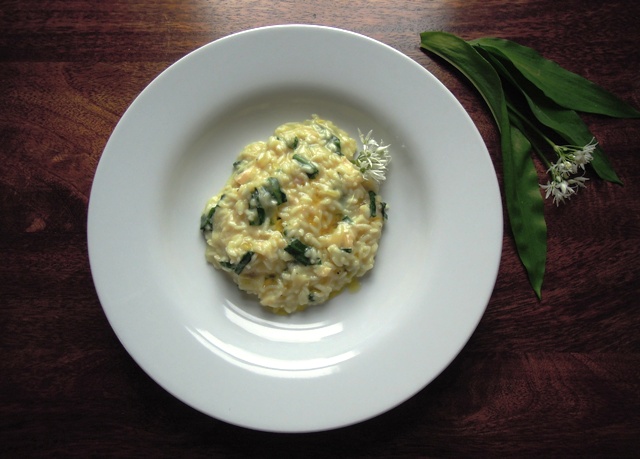
Last weekend we tried it in a risotto and it was an absolute triumph. Grown ups and children enjoyed it alike. I was impressed by the fact it tasted so special, almost extravagant, even though one of the main ingredients was completely free. Perfect family food on a budget. It felt good to pop down the lane with my oldest daughter, grab a few bunches and within half an hour or so turn it into a delicious feast.
I plan to try it in a pesto next week, so watch this space.
In the meantime, here’s my recipe for wild garlic risotto. I happened to have some leftover chicken from another meal in the fridge so I’ve added this but I think it would work equally well without.
Wild garlic risotto
Serves 4
2 tbsp olive oil
1 onion, peeled and finely chopped
320g arborio risotto rice
1 litre hot chicken or vegetable stock
300g cooked chicken, torn or cut into bitesized pieces (optional)
2 large handfuls wild garlic leaves, washed and roughly shredded
100g Parmesan cheese, grated
Salt and pepper
Extra virgin olive oil and wild garlic flowers to serve
Gently cook the onion in the olive oil in a large frying pan for around 10 minutes until golden. Add the rice and fry for another couple of minutes.
Stir in the hot stock to the rice a ladleful at a time, allowing the liquid to be absorbed before adding more. Keep going until you have added almost all the stock.
As the last ladleful goes in, throw in the wild garlic and (if you’re using it) cooked chicken, and stir together for two to three minutes.
Just before serving, stir in the Parmesan cheese and a grind of salt and pepper to taste. Plate up, drizzle with a little extra virgin olive oil and decorate with a wild garlic flower or two.
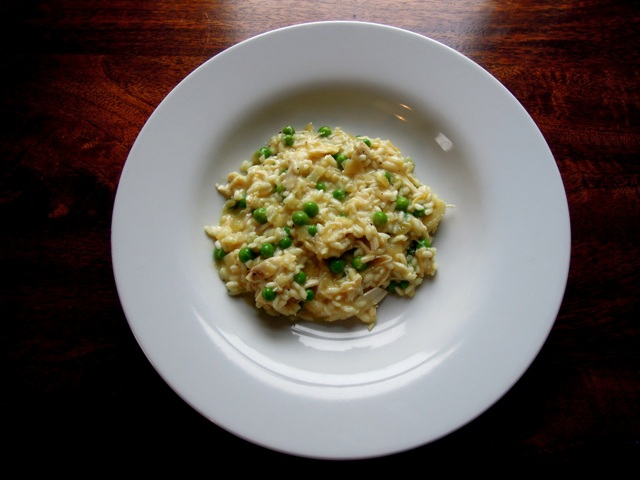
There are certain dishes that make you feel good simply by preparing them, even before you get to the eating of them. This risotto is, for me, one of these dishes.
It’s partly because it consists mainly of leftovers. The chicken comes from a roast chicken we enjoyed a couple of days earlier, while the stock was made from the bones of the same bird. Spreading ingredients over two or three meals in this way makes me feel quite virtuous, like a proper old fashioned cook.
And then there’s the way you cook a good risotto. It takes care and patience. You can’t turn your back on it for too long. It takes love, and in return you feel loved for making it.
People can be put off making risotto because they dislike the idea of having to stand over the pan, constantly stirring the rice. I know I used to be. But really, it’s only 20 minutes of your life, and it can be almost therapeutic to stand there and let your mind wander. It’s almost like meditation.
Finally, of course, it tastes so good. Just a few simple ingredients and a bit of stirring and you end up with a creamy hug on a plate. Most definitely my idea of the perfect comfort food.
Chicken and pea risotto
Serves 4
2 tbsp olive oil
1 onion, peeled and finely chopped
2 cloves of garlic, peeled and crushed
320g arborio risotto rice
300g (approx) cooked chicken, torn or cut into bitesized pieces
1 litre hot chicken stock (homemade or from stock cubes)
250g frozen peas
100g Parmesan cheese, grated
Salt and pepper
Gently cook the onion in the olive oil in a large frying pan for around 10 minutes until golden. Add the garlic and rice and fry for another couple of minutes.
Stir in the hot stock to the rice a ladleful at a time, allowing the liquid to be absorbed before adding more. Keep going until you have added almost all the stock.
As the last ladleful goes in, throw in the peas and the chicken and stir together for two to three minutes.
Just before serving, stir in the Parmesan cheese and a grind of salt and pepper to taste.
Food snobs will roll their eyes to see a recipe for chicken tikka masala. It’s not an authentic Indian curry, is it? No-one in India actually eats it, do they?
But I really don’t care. Chicken tikka masala is one of my favourite dishes to order in an Indian restaurant. It’s so moreish and familiar and comforting. And I think it deserves its place as one of Britain’s favourite meals.
And it’s the restaurant style chicken tikka masala my husband recently decided he wanted to have a go at making at home. We came across a recipe by The Curry Guy, aka Dan Toombs, and Jason just had to give it a go.
Dan’s recipe is excellent and, if curry is your thing, I really recommend you try it. It’s a good family meal as it’s creamy and softly spicy rather than fiery hot. But it’s not a quick dish to throw together. If you want to make it the way they do in restaurants, there’s quite a lot of preparation involved.
But when it comes to preparation, my husband Jason is undoubtedly your man. He’s measured and methodical, whereas I am messy and impatient. At the end of one of my cooking sessions, you’d think a tornado had blown through the kitchen. But when Jason is in charge, order and serenity reign.
Talk about tidy in the kitchen...
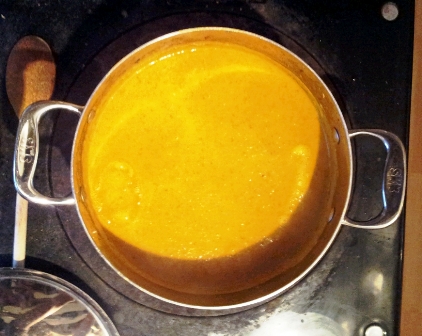
His first job was to make up a big batch of curry gravy, which Jason reckons took him about two hours. And when I say big, I mean big.
This curry gravy will keep us going a while!
This sauce forms the basis of many of the curries you’ll come across in an Indian restaurant. Apparently you can use it to “make everything from mild kormas to violently hot phall curries in no time”.
Dan’s recipe makes enough gravy for eight curries and it freezes well. So one down, seven more to go! I’d quite like to give his recipe for madras a whirl next time.
Anyway back to the tikka masala. Once you’ve got the gravy, you then need to pre-cook your chicken. Again you can freeze this and use in a number of different chicken curry recipes.
However this time Jason decided to scale down the quantities (our freezer couldn’t take much more!) and made just enough for this one dish. This stage took around another hour.
So once you’ve got your gravy and your chicken, you’re then ready to bring these together with more spices and cream. This final stage takes another hour.
Stirring in single cream
And – if you really want it to look like the chicken tikka masala you’d order in your curry house – you can also add a few drops of red food colouring.
Now doesn't that look a fantastic colour?
So all in all, it’s quite a complicated recipe and it takes time. Jason spread the different stages out over three separate days. But it is worth it. It is exactly like a chicken tikka masala you’d have in a restaurant. Both our daughters, who are aged six and three, really enjoyed it too. We served it with cucumber raita just in case it was too hot for them, but the spice wasn’t a problem for either of them.
A big hit with all the family
And we’ve now got lots of lovely gravy in the freezer all ready to transform into seven more curries in the coming weeks. Can’t wait!
This year I got it into my head that I was going to cook my family a proper feast to celebrate Chinese New Year and welcome in the year of the dragon.
I don’t normally celebrate Chinese New Year, despite being part Chinese. My mother grew up on the Malaysian island of Penang and is half Chinese and half Dutch. So you see I’m only a little bit Chinese. But mum has always talked about Penang as home, so I do feel a strong connection and I adore the food.
There’s been lots of talk about Chinese New Year amongst the foodie Twitter and blogging community, which really spurred me on. Trouble is I don’t have the first clue how to cook Chinese food.
And so I called in help from the Chinese members of my family who happen to be scattered around the world. Facebook is a fantastic tool for this kind of thing. I asked them what should I cook for a Malaysian Chinese feast and, more importantly, how do I do it?
Kian chai – I think!
The menu and recipes below come from my Aunty Lorene in the US, Aunty Kim in Canada, cousin Edhish in Sweden, cousin Jezalina in Australia and mother Cheryl in Spain.
All agreed I had to cook Kian Chai Teng, a soup made from Chinese salted vegetables, pork ribs and sour plums, served with chopped chilli and steamed white rice. I’m not 100% sure I got the right vegetables in the Chinese supermarket, although the lady who worked there insisted they were the thing to use.So I’m not sure if I made an authentic Kian Chai Teng, but it sure tasted good. The children gobbled it down enthusiastically and enjoyed picking the beautifully tender meat from the bones.
Penang Char Kway Teow
Next was Char Kway Teow, a Penang fried noodle dish. You should use shrimps and squid but as my husband can’t eat seafood I swapped these for chicken and Chinese sausage. Again not totally authentic but absolutely gorgeous nonetheless.
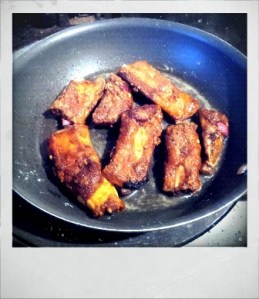
My mum suggested Chinese spare ribs and gave me her Aunty Seck’s recipe and I also came up with my own recipe for Chinese roast chicken drumsticks. Plus a big bowl of pak choi steamed with ginger.
It was a fine, fine feast. As is my tendency, I cooked way too much food, so we ate the leftovers for Sunday lunch. The spare ribs in particular tasted even better second time around.
I have to say a heartfelt thank you to my relatives for their advice and supportive words. One day it would be wonderful if we could all get together to celebrate new year somehow. Oh, and of course, gung hay fat choy everyone!
Kian Chai Teng – soup with pork ribs and salted vegetables
In a large pan, gently fry the onion in the oil until golden.
Place the pork ribs, garlic and ginger into the pan and enough water to cover. Bring to the boil, then add the soy sauce and rice wine. Turn down the heat so that the soup is on a very low simmer and cook for at least an hour, until the meat is starting to fall off the bone.
Taste your salted vegetables. If they are very salty, you may need to give them a thorough rinse so they don’t make your soup too salty.
Add the potatoes and salted vegetables. Put the lid back on and simmer for another 30-40 minutes.
Serve the soup with a saucer of soy sauce and cut chilli and a plate of steamed white rice.
My Char Kway Teow
Serves 6-8
2 tbsp dark soy sauce 3 tbsp light soy sauce 2 tbsp water 4 tbsp peanut or vegetable oil 4 cloves garlic, crushed 2 chicken breasts, chopped into small pieces 1 lap cheong (Chinese pork sausage), cut diagonally into thin slices 500g flat rice noodles 2 eggs (duck eggs if you can get them – I used hen eggs) 4 large handfuls bean sprouts salt and white pepper
In a small bowl, mix the dark and light soy sauces with the water, and put to one side.
Heat the oil in a wok on a high heat and stir fry the garlic for a few seconds before adding the chicken. Cook until the chicken turns white, then add the sausage and stir fry for another minute.
Add the noodles and sprinkle with the soy sauce mixture, and add salt and pepper to taste. Gently stir fry for three to four minutes.
Make a space in the middle of the work and break the eggs into the hole with a little pinch of salt. Roughly scramble the eggs and then combine with the noodles. Stir fry for another five minutes.
Finally add the bean sprouts, fry for another minute and then serve.
Spare ribs
Chinese spare ribs
Serves 4
550g pork spare ribs 4 cloves garlic, crushed ½ tsp light soy sauce ½ tsp dark soy sauce ½ tsp Shaoxing (Chinese rice wine) Salt and pepper 1 tbsp tomato sauce 1 tbsp Worcester sauce ½ tbsp sesame oil ½ tbsp sugar 3 tbsp tapioca flour 3 tbsp vegetable oil
Preheat the oven to 200°C/Gas Mark 6.
In a small bowl mix together the garlic, soy sauces, rice wine, salt and pepper. Pour over the spare ribs, make sure thorougly coated and leave to marinade for at least an hour.
Prepare the sauce. In another bowl, combine the tomato sauce, Worcester sauce, sesame oil, sugar and 3 tbsp water.
Coat the spare ribs in tapioca flour and fry in hot oil over a medium heat for around five minutes. You may need to do this in batches. Remove, drain on absorbent paper and place on a baking tray. Roast in the oven for 10 minutes.
Heat the sauce until it thickens. Take the ribs out of the oven, place in a serving dish and pour over the sauce.
My Chinese chicken
4 chicken drumsticks 4 chicken thighs
For the marinade:
2 tbsp runny honey 4cm ginger, peeled and finely chopped 2 garlic cloves, crushed 2 tsp Chinese five spice 2 tsp light soy sauce 1 tbsp red currant jelly 1 tbsp sesame oil
Preheat the oven to 200°C/Gas Mark 6.
Slash the drumsticks with a sharp knife and place in a bowl with the thighs.
Mix together all of the marinade ingredients and pour over the chicken, making sure they are well coated. Leave to marinade for at least two hours or overnight.
Put the chicken pieces on a roasting tray with a few spoonfuls of the marinade and place in the oven for 40-45 minutes, turning occasionally and spooning over more marinade if it looks like it is drying out.
Also great served cold as part of a picnic or in a packed lunch.
I’ve been making this meal for my children since the oldest was about a year old. It’s incredibly easy to make and is good for getting little ones used to different textures.
When they’re very little, you’ll need to chop up the chicken and vegetables quite small, but as they get older you can leave the ingredients more chunky.
It’s a firm favourite with both my kids and I often cook up a big pot and freeze portions for easy midweek meals. They’re now six and three and their eyes still light up when I tell them they’re having it for tea.
Feel free to play around with the vegetables you include. I often swap the courgette for peas or sweetcorn. I also used to use mushrooms until the oldest decided one day they were the devil’s food!
Tasty chicken rice
200g basmati rice
2 tbsp sunflower oil
1 onion, chopped
1 green or red pepper, chopped
1 courgette, diced
2 garlic cloves, crushed
1 tbsp chopped parsley
1 skinless chicken breast, chopped
450ml passata
100ml chicken or vegetable stock
salt and pepper
Cook the rice following the instructions on the packet.
Heat the oil in a large pan and gently fry the onion, pepper and courgette for about five minutes. Add the garlic and parsley, fry for another minute or so before adding the chicken.
Cook until the chicken turns white, then add the passata and stock. Simmer gently for 15 minutes.
Drain the rice and combine with the chicken sauce. Taste and add seasoning if needed.
I’m entering this dish into the Family Foodies challenge which Louisa at Eat Your Veg and I take turns to host. It’s Louisa’s turn this month and the theme is The Under Twos.













 Bangers & Mash