Meal plan: 5 February 2012

It’s been a rather good week for food in our house. Plenty of pies, bakes, soups and stews to keep us warm. Plus there was the added bonus of some rather tasty meals at my sister-in-law’s at the weekend whom we visited to help celebrate her 50th birthday.

Highs

The award for my food highlight of the week has to go to braised pig cheeks.

Braised pig cheeks with celeriac mash

Most people I’ve mentioned this dish to have given the same rather squeamish response but it is truly an amazing meal. You’ve got to try it. And it’s so cheap too. I got six pig cheeks from my butcher for just £4 and that’s enough to feed four people.

You slow cook the cheeks in red wine and vegetables until they are sumptuously tender and practically melt in your mouth. Pure heaven on a plate. I’ll post the recipe on the blog very soon. I promise.

Another food highlight, a regular in our house during the winter months, was the sausage and cabbage bake. Savoy cabbage is particularly good this time of year and so I entered my bake into the In Season Challenge over at Bake It, Make It, where you’ll find more recipes using this marvellous vegetable.

Lows

It’s been a tricky task coming up with what I’d call a low this week. So I’m plumping for what was more of a disappointment. Not in the dish itself but in my daughters’ reaction to it. I baked Lorraine Pascale’s pumpkin and rosemary muffins. My husband and I thought they were delicious but the kids weren’t convinced.

So here’s what we ate last week:

Monday 30 January
Lunch: pasta salad
Dinner: sausage and cabbage bake

Tuesday 31 January
Lunch: carrot, coriander and ginger soup
Dinner: cottage pie

Wednesday 1 February
Lunch: pumpkin and rosemary muffins 
Dinner: braised pig cheeks with celeriac mash

Thursday 2 February
Lunch: butternut squash soup, ham salad rolls
Dinner (kids): spaghetti bolognese F (adults): beef stew and parsley dumplings F

Friday 3 February
Lunch: rice salad
Dinner: baked potatoes, garlic mushrooms and salad

Saturday 4 February
Lunch: stir fried spring greens and noodles
Dinner: AWAY

Sunday 5 February
Lunch: AWAY
Dinner: butternut squash soup and bread rolls

F = from freezer

Meal plan: 29 January 2012

It might have taken a day to prepare, but our Chinese new year meal was fantastic

I’m very happy to say it’s been a good week for meals in our house. Lots of old favourites and some new experiments too.

Highs

The outstanding highlight of our culinary week has to be the Chinese new year feast on Saturday.

Food is a great way to bring families together, and for me this was true despite my family being scattered across the world.

I’d sent out a plea to aunts and cousins and not only recipes came back, but a whole host of wonderful food memories.

It was quite special to know that both my cousin in Sweden and I were preparing the same soup for our families, and still eating leftovers several days later!

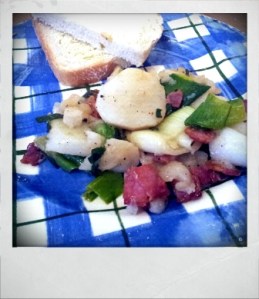
Jerusalem artichokes with bacon, leeks and sage

Another highlight were the Jerusalem artichokes for supper on Tuesday.

I cooked them with bacon, leeks and sage using a Riverford recipe and served them simply with big hunks of buttered bread. Truly gorgeous and very satisfying.

On Friday night we had a family favourite: beef stew and parsley dumplings, a perfect winter warmer, which went down well with my husband after an exhausting game of squash.

Lows

I’m feeling quite smug in being able to say there were no kitchen disasters this week. The only downside to our week’s eating was the morning-after windiness following the delicious artichokes!

It doesn’t really constitute a low but I wasn’t totally happy with my pizza muffins for the children’s lunch boxes. I think that recipe will need a little work before I publish it.

Monday 23 January
Lunch: healthy green soup and sandwiches
Dinner: spaghetti bolognese

Tuesday 24 January
Lunch: healthy green soup and sandwiches
Dinner: mutton curry F

Wednesday 25 January
Lunch: pizza muffins
Dinner: Jerusalem artichokes with bacon, leeks and sage

Thursday 26 January
Lunch: cheese and pickle rolls
Dinner (kids): minestrone soup F (adults): stuffed chicken breasts with beetroot and potato dauphinoise

Friday 27 January
Lunch: rice salad
Dinner: beef stew and parsley dumplings

Saturday 28 January
Lunch: bread, cheese and salad
Dinner: Chinese New Year meal

Sunday 29 January
Lunch: Chinese leftovers
Dinner: Hummus, bread and salad

F = from freezer

Homemade pizza

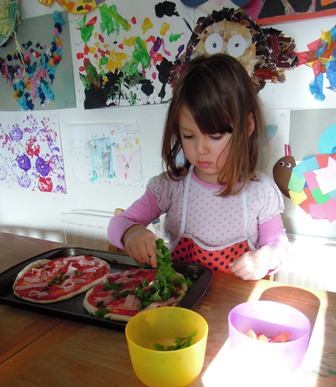
Pizza has to be one of the best things to cook with children, and homemade pizzas always taste so much better than the ready-made variety. Children, well mine anyway, seem more inclined to eat something if they’ve been involved in the making of it.

OK, so it might turn into a slightly messy affair. I used to come close to panic attacks when I first started cooking with the kids and ingredients would go flying everywhere.

But I’ve learned to just go with the flow; it can all be cleaned up afterwards.

It really is worth it to get your children used to helping make meals and forming a positive relationship with food.

I much prefer to make my own dough but I am not too proud to admit to cheating now and again. I generally keep some shop-bought pizza bases in the freezer too; perfect for when little friends stay for tea unexpectedly. My children think it’s great to make pizzas with their friends and having some frozen bases on standby means we can always rustle some up at a few moments’ notice.

If you have a little more time though (pizza dough takes an hour to rise), I would strongly recommend making your own dough from scratch. It is so incredibly easy and I’ll never get over the magical feeling of seeing the dough increase to double its size. It’s like a science experiment in the kitchen.

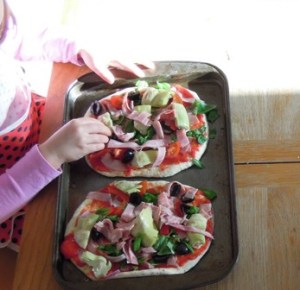
What ingredients you put on top of your pizza is very much down to personal taste and, of course, what your children like to eat. If you make a little pizza each, everyone can choose their own favourite toppings.

And don’t forget, cold pizza is great the following day in a packed lunch, so always a good idea to make a bit extra.

We like a lot of topping in our house!

Homemade pizza

Makes four pizzas

For the dough:

400g strong white bread flour
1 tsp salt
1 7g sachet fast action dried yeast
1 tsp dried oregano
250ml luke warm water
1 tbsp olive oil

Passata, about half a jar

Our favourite toppings:

Cherry tomatoes, halved
Small red, green or yellow pepper, chopped small
Fresh basil, torn
Pitted black olives
Ham or salami, chopped
Capers
Artichoke hearts, quartered
Mozzarella (a couple of balls, around 250g each, should be enough for four pizzas)

To make the dough, put the flour, salt, dried yeast and oregano into a large mixing bowl and mix well.

Make a well in the  middle and pour in the lukewarm water and oil. Gradually work the flour into the liquid, making a soft dough. If it’s too dry, add a drop more water. If it’s too sticky, add a little more flour.

Flour your surface before tipping the dough onto it. Knead the dough by stretching it away from you, then pulling back into a ball. Do this for five minutes or so, until the dough is smooth and elastic.

Return the dough to the mixing bowl, cover loosely with cling film and put in a warm place for about an hour, until the dough has doubled in size.

Preheat the oven to 200°C/Gas Mark 6.

Uncover the risen dough and punch it back down. Flour the surface again and divide the dough into four balls. Stretch or roll out each ball until you have a thin circle about 22cm across. Place the pizzas onto slightly oiled baking sheets.

Pour a couple of tablespoons of passata onto each pizza, smooth out with the back of the spoon, and then let the artist in you run free while you apply your choice of toppings, leaving the mozzarella until the end.

Bake your pizzas for 15-20 minutes and leave to cool for a couple of minutes before devouring.

Why bangers and mash?

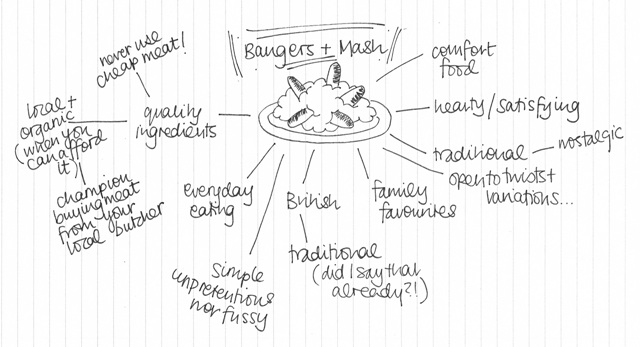
A few people have asked why I called this blog Bangers & Mash. So here’s a sophisticated diagram to help explain.

Quite simply Bangers & Mash sums up the kind of food I like to cook and eat.

Simple and unpretentious.

Terrible if you use cheap sausages or don’t put butter in the mashed potato, but when you use quality ingredients it just can’t be beaten.

And that’s the kind of food you’ll find me talking about in this blog.